Storm
Damage
Roofing
DuPage County averages 4–6 significant hail events per year. Most homeowners have compensable storm damage on their roof right now and don't know it. We document it, manage your insurance claim, and deploy GAF Master Elite® certified crews to restore your roof — often at zero out-of-pocket cost beyond your deductible.
Types of Storm Damage We Restore
Illinois weather produces four distinct damage mechanisms — each leaves different evidence, each has different insurance implications. Here's how to identify what you have.
Hail Damage
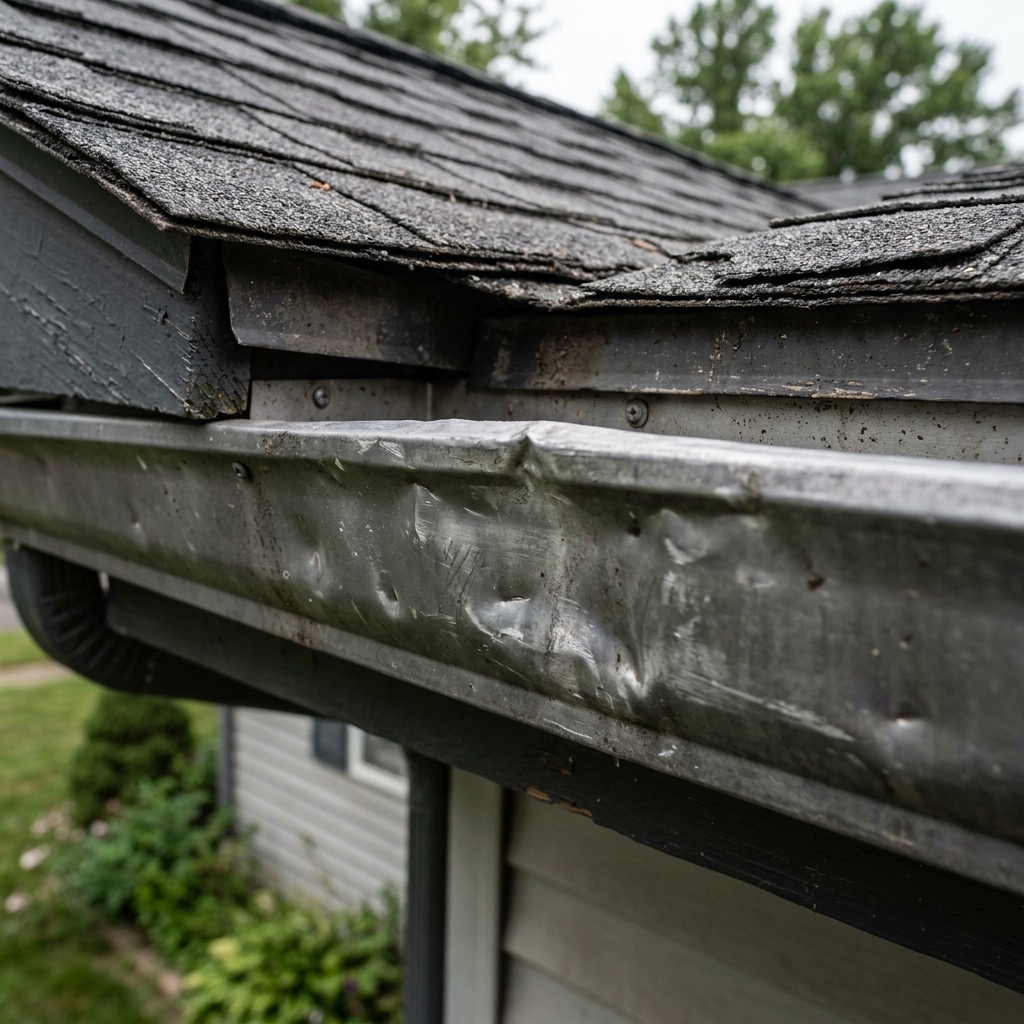
Hail is the most common and most frequently missed storm damage type in DuPage County. Impacts at 1.5" diameter and above cause what inspectors call functional damage — the granule layer is displaced, the fiberglass mat is fractured, and UV resistance is compromised — even when the shingle surface looks intact from the ground. Insurance carriers classify this as a covered loss regardless of whether active leaking has begun.
What to look for:
- Dark circular bruise marks on shingle surface (soft spots under pressure)
- Granule accumulation in gutters and downspout splash blocks after the storm
- Dents on aluminum gutters, fascia, or AC condenser fins (the most visible ground-level indicator)
- Paint chips on painted wood surfaces, window screens, or wood decking
Insurance note: Hail damage is typically a covered peril under ACV (actual cash value) or RCV (replacement cost value) policies. Most Illinois homeowners only pay their deductible. The key is filing before your policy's reporting window — usually 30–60 days from the storm date.
Wind Damage
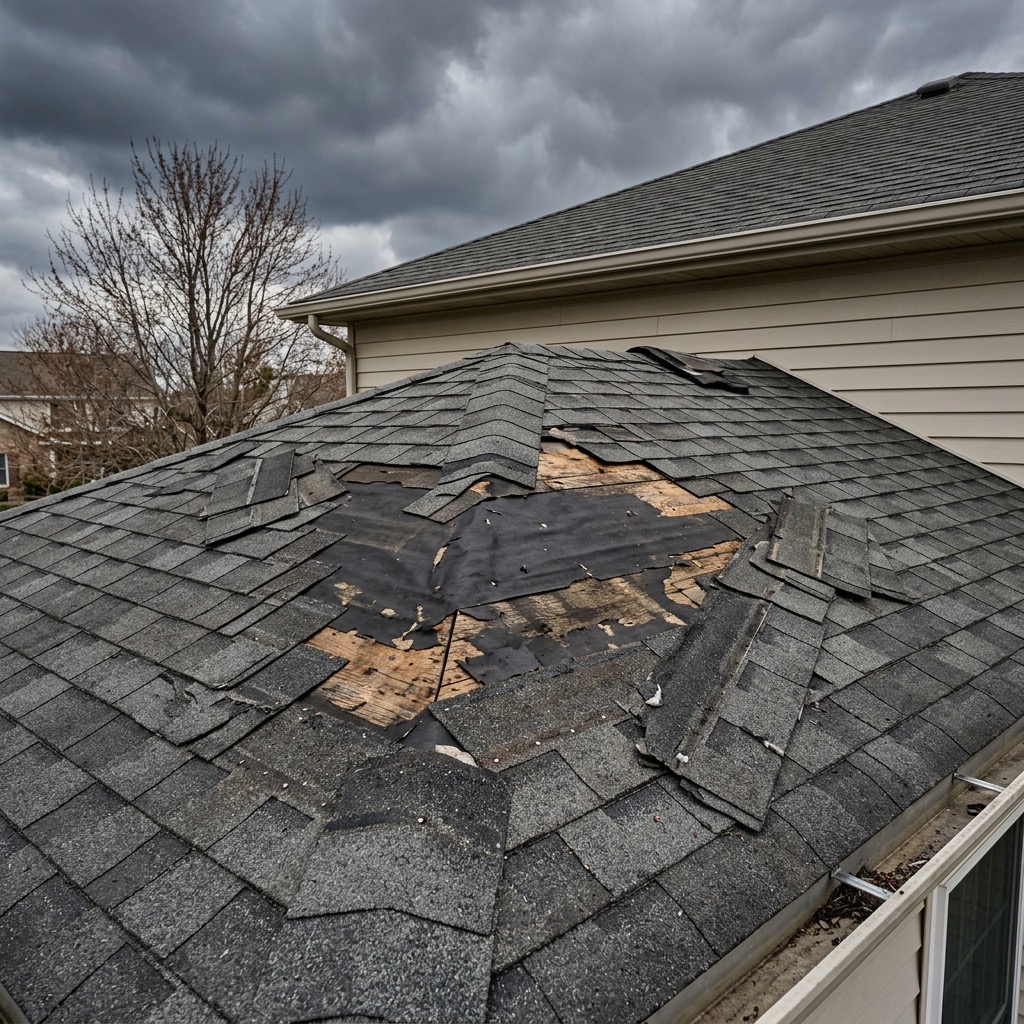
Straight-line winds above 50–60 mph are common in DuPage County severe thunderstorms and produce two primary failure modes: uplift damage (shingles lifted, seal-strip broken, nails exposed) and tab cracking (shingle tabs cracked or folded at the mid-point). Both compromise the waterproofing layer even when shingles remain partially in place. Wind damage at ridge caps and rakes — the highest-wind-load zones — is the most common presentation.
What to look for:
- Missing shingles or shingle tabs visible from the ground
- Lifted or misaligned ridge cap shingles (most wind-exposed zone)
- Crease lines across shingle tabs — visible as a horizontal fold or crack
- Debris impact marks from tree limbs, branches, or airborne objects
Insurance note: Most policies require wind speeds above 40–50 mph for a covered loss. NOAA wind event records for your ZIP code establish the qualifying event. We pull this documentation as part of every storm claim we file.

Ice Dam Damage
Ice dams form when heat from an under-insulated attic melts snow on the upper roof; meltwater runs down to the cold eave overhang, refreezes, and builds an ice ridge. Subsequent meltwater is blocked and backs up under the shingles. The result: water infiltration at the eave, saturated insulation, ceiling staining, and in severe cases, structural sheathing rot — all from a process invisible until interior damage appears.
What to look for:
- Large icicle formations at eave edges during or after winter storms
- Water stains on interior ceiling near exterior walls — especially in spring
- Lifted or cracked eave shingles after ice season
- Paint bubbling or peeling on interior wall near exterior ceiling line
Insurance note: Ice dam damage is covered under most Illinois HO-3 policies as a water damage peril. The fix is two-part: address the immediate damage (shingles, underlayment, interior) and resolve the underlying ventilation and insulation deficiency to prevent recurrence.
Impact & Debris
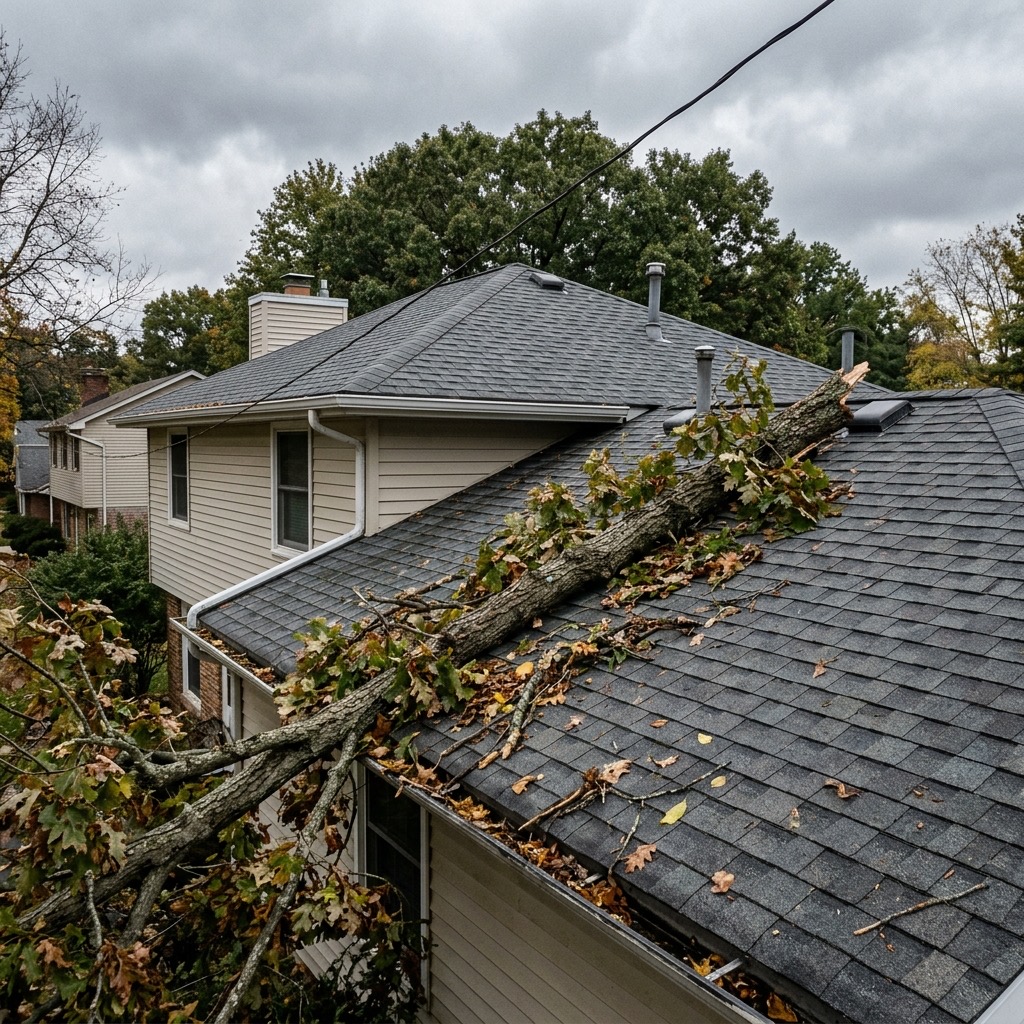
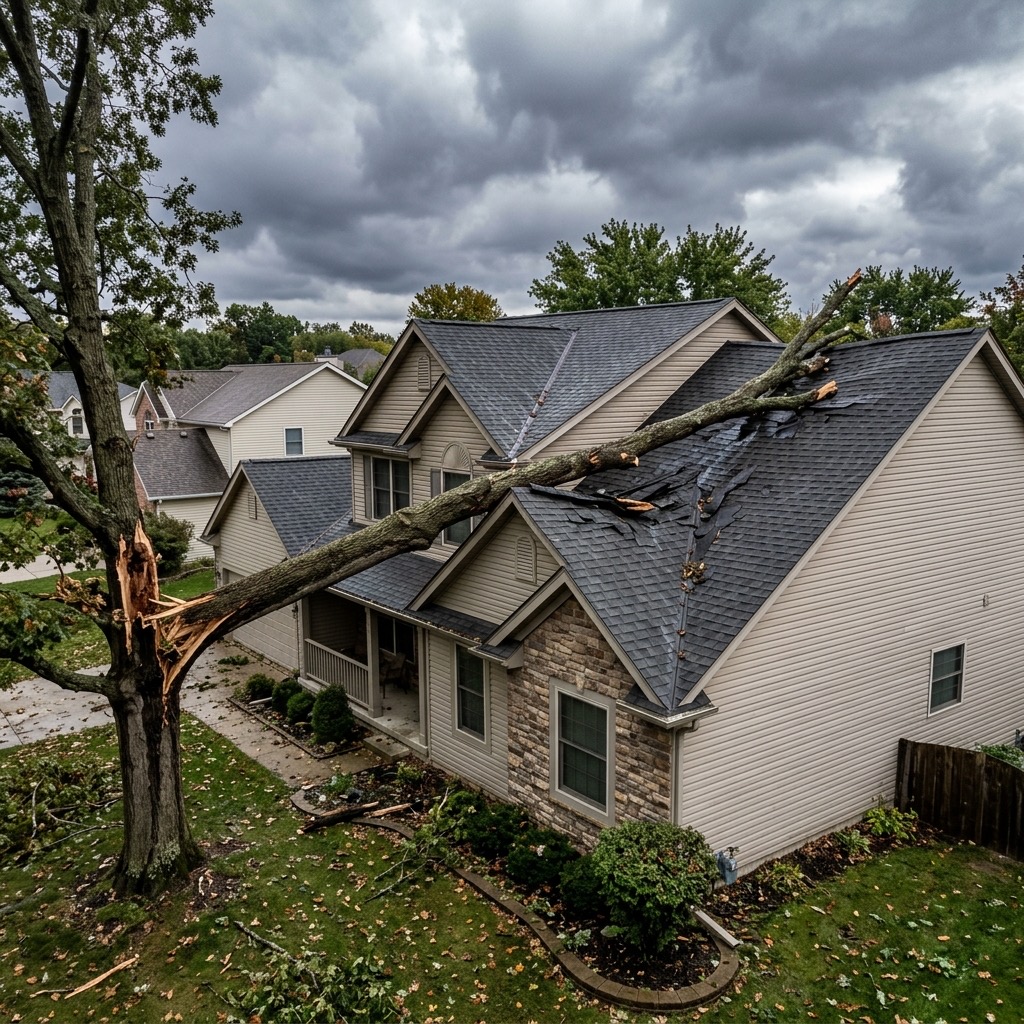
Tree limb impacts, falling branches, and airborne debris during severe storms are the most structurally visible storm damage type — but also the most likely to involve decking and rafter damage below the shingle surface. The visible shingle puncture or displaced area is rarely the full scope; structural evaluation of the impact zone is required before repair to understand whether decking replacement is needed.
What to look for:
- Visible hole, crack, or displacement in shingle field
- Sagging or soft spot in roof deck when walked
- Crushed or displaced gutter sections
- Active water intrusion within hours of the storm event
Insurance note: Falling object and wind damage are both named perils under standard HO-3 policies. If a neighbor's tree caused the damage, your carrier typically handles the claim and pursues subrogation — not a process you have to manage personally.
How We Manage Your Insurance Claim
Most roofing contractors hand you a quote and tell you to call your insurance company. We manage the entire process — from documentation through final payment — so you don't have to.
Free Storm Damage Inspection & Documentation
A GAF Master Elite® inspector walks your full roof and documents every damage zone with GPS-tagged, date-stamped photography. We identify hail strike density, wind-uplift zones, and secondary damage to flashings, gutters, and fascia. The inspection report is formatted to meet insurance carrier documentation standards — including a cross-reference with NOAA weather event records confirming the storm date and size for your ZIP code.
Guided Claim Filing — We Coach Every Step
Before you call your carrier, we walk you through the exact language to use. The difference between "I think there might be some damage" and "I am reporting functional storm damage from the [date] hail event consistent with NOAA-recorded storm activity, and requesting an adjuster inspection" can mean the difference between a full approval and an initial denial. We also advise on when to file versus when to wait — some storm sequences produce multiple events, and filing strategically can protect your claims history.
Adjuster Accompaniment — We're On Your Roof
When your insurance company sends an adjuster to inspect, our representative meets them on-site and walks the roof together — a practice called adjuster accompaniment. We reference our documentation side-by-side with the adjuster's inspection, ensure all qualifying damage zones are included in the scope, and provide technical context (ASTM standards compliance, moisture detection via thermal imaging, hail strike patterns, functional damage criteria under HAAG Engineering standards) that a homeowner alone could never provide. Homeowners who use adjuster accompaniment recover 30–40% more in approved scope on average.
Approval & Supplement Review
Once the initial approval arrives, we review the insurer's scope against our documentation. Adjusters frequently undercount damage zones, use outdated labor rates, or exclude code-required upgrades (new drip edge, ice shield, permit fees) that are legitimate line items. We submit supplement requests with supporting documentation for every legitimate line item the initial approval missed — at no additional cost to you. Supplement approval rates in our managed claims run above 85%.
GAF Master Elite® Installation
Installation proceeds under the insurer's approved scope — performed by a GAF Master Elite® certified crew, not a standard subcontractor. Full tear-off, synthetic underlayment, ice-and-water shield at all eaves and penetrations per Illinois building code, new flashing at all penetrations, and your chosen shingle product (such as GAF Timberline UHDZ or impact-resistant ArmorShield II). Every install is eligible for the Golden Pledge® Warranty. Most Naperville homes are completed in one to two days. Permit pulled by us, inspection scheduled with your municipality.
Final Invoice & Warranty Delivery
Your invoice goes directly to your insurance carrier for payment against the approved scope. Your out-of-pocket is your deductible — nothing more. GAF Golden Pledge® warranty certificate (50-year, transferable, covering materials and workmanship) delivered same day. Magnetic nail sweep of the full property. Debris removal complete before crew departs.
ACV vs. RCV: What Your Policy Actually Pays
The single most important thing to know before filing a storm claim in Illinois. The difference between an ACV and RCV policy can mean $4,000–$8,000 in out-of-pocket cost on a typical Naperville roof. Here's exactly how each works.
ACV — Actual Cash Value
The insurer pays the current depreciated value of your damaged roof — not what it costs to replace it. A 15-year-old roof may have depreciated 50–60% of its replacement value. On a $14,000 replacement, an ACV policy might pay $6,000–$7,000 after your deductible. The remaining $7,000–$8,000 is your out-of-pocket responsibility.
What to do: Ask your agent about an RCV endorsement at renewal. The premium difference is typically $80–$180/year — far less than the depreciation gap in a storm claim. We can advise before you file.
RCV — Replacement Cost Value
Best CoverageThe insurer pays the full cost to replace the damaged roof with a like-kind-and-quality system at current market prices (often calculated using industry-standard software like Xactimate or Symbility). The payment for your property claim is typically split: an initial ACV check (minus depreciation), then a recoverable depreciation check released once the work is completed. After we submit the Proof of Loss and final Letter of Completion, the remaining funds are released. On that same $14,000 replacement, your RCV policy pays $13,000–$13,500 after your $500–$1,000 deductible.
What to do: Do not cash the first check without scheduling the work — the recoverable depreciation check is only released once you complete the project and submit the final invoice. We manage this paperwork for you.
7 Mistakes That Kill Storm Roof Claims
We've managed 1,200+ claims across DuPage and Will County. These are the mistakes that result in reduced settlements, outright denials, or policy non-renewals — all of which are preventable.
Missing the Filing Window
Most Illinois policies require damage reporting within 30–60 days of the storm date — not the date you discover it. Post-season hail from May often isn't found until August, but the clock started in May. File within 30 days of any significant storm, even before you're sure damage exists.
Letting the Adjuster Inspect Alone
Insurance adjusters work for your carrier, not for you. An unaccompanied adjuster misses an average of 20–30% of compensable damage on residential roofs — not necessarily from bad faith, but because they inspect dozens of roofs per day and lack the depth of a dedicated roof inspector. Always have a roofing professional present.
Accepting the First Settlement Offer
Initial approvals routinely exclude code-required upgrades (drip edge, ice shield, permit), use outdated Xactimate labor rates, or miss secondary damage zones entirely. Every claim we manage includes a supplement review — and we recover additional scope in the majority of cases.
Cashing the First Check Before Work Begins
On RCV policies, cashing the ACV check without completing the work triggers a complex process to recover the depreciation payment — and some carriers use it to argue the claim is settled. Hold both checks until the project is complete and all documentation is submitted.
Hiring a Storm Chaser
After major hail events, Naperville sees an influx of out-of-state contractors offering same-day deals. They have no IL license, no permanent address, and often disregard the Illinois Home Repair and Remodeling Act — which requires specific consumer rights brochures and 3-day cancellation clauses. As a legally compliant enterprise, we provide all mandated documentation. Any contractor worth hiring will still be available in six weeks; there's no rushed urgency.
Agreeing to Deductible Waivers
A contractor who offers to "eat your deductible" is committing insurance fraud under Illinois law — and so are you for accepting it. The deductible is your contractual responsibility. Any contractor making this offer has incentive to inflate the scope to cover their cost, which exposes your policy to fraud investigation.
Not Documenting Pre-Existing Condition
Carriers will attempt to attribute damage to pre-existing wear rather than the storm event. Our inspection report includes a pre-storm condition baseline where discernible — and our NOAA documentation ties the damage to a specific, recorded weather event. This shifts the burden of proof in your favor.
What Happens If My Claim Is Denied?
An initial denial is not the final word. Here is the step-by-step logic we follow when an adjuster denies a legitimate storm damage claim:
Request Re-inspection
We file a formal request for a second adjuster, presenting our GPS-tagged, HAAG-certified photo documentation that proves functional damage was missed during the initial visit.
Engineering Review
If the second adjuster disagrees, we can request an independent engineering review using ASTM standards to formally document the storm-induced damage versus standard wear and tear.
Appraisal Clause
As a final measure, we guide you to invoke the Appraisal Clause in your policy, bringing in an independent third-party umpire to settle the dispute fairly based on hard evidence.
DuPage County Is One of Illinois' Most Hail-Active Counties
The convergence of Lake Michigan moisture and continental air masses makes the I-88 corridor — running directly through Naperville, Aurora, and Downers Grove — one of the most hail-active corridors in the state. The NOAA Storm Events Database records DuPage County experiencing significant hail (1" diameter or larger) events every single year for the past two decades without exception.
During the typical Illinois Hail Season (April–June), storm activity spikes significantly. The 2023 hail season alone produced three events above 1.5" in DuPage County — the threshold at which standard architectural shingles sustain functional damage regardless of their age. We processed 340 residential storm claims that year. Stay updated on our Naperville Storm Center for a log of Recent Storm Activity. Of those homeowners, fewer than 15% had noticed any visible damage before calling us for an inspection.
"We've never charged a Naperville homeowner more than their deductible on a covered storm claim."
"Storm damage roofing is where fly-by-night contractors do the most damage to homeowners — bad installs, inflated scopes, waived deductibles that constitute fraud, warranty paper that's worthless because the company doesn't exist in two years. We've been in Naperville since 2005. Every claim we manage is something we're accountable for in five years, ten years, and twenty years. That accountability is the only thing that matters in this business."

Storm Damage Roofing FAQ
How do I know if the storm that hit Naperville damaged my roof?
The honest answer is: you often can't know without getting on the roof. Hail bruising — the most common storm damage type in DuPage County — is invisible from the ground. It looks like a normal shingle from the street but has sustained granule displacement and mat fracture that shortens the shingle's life by years and voids the manufacturer warranty. The only reliable way to determine if you have compensable storm damage is to have a trained inspector on the roof with a calibrated eye for hail patterns. We provide that inspection free, with no commitment. If there's no damage, we document that and leave. If there is damage, you'll have the documentation needed to file a claim before the reporting window closes.
Does insurance pay for a whole new roof if only a few shingles are missing?
In many cases, yes. This relates to Matching Laws and Line of Sight rules in Illinois. If the damage is localized but new shingles cannot reasonably match the existing roof (due to fading, weathering, or the product being discontinued), your insurance carrier is often obligated to pay for a full roof replacement to maintain a "uniform and consistent appearance." We document these matching challenges explicitly for the adjuster.
Will filing a storm claim raise my homeowners insurance rates?
A weather-related claim in Illinois is a non-fault claim — it is caused by a covered peril, not by the homeowner's behavior. Most major Illinois carriers do not surcharge premiums for a single weather-related claim, and many have explicit no-surcharge policies for the first weather claim within a policy period. The greater risk to your premium is having a damaged roof that generates a second, more severe claim (interior water damage, structural rot) down the road — which is a more significant actuarial event. We advise every homeowner on their specific policy's claim history before they file, so you can make an informed decision.
My insurance adjuster said there's not enough damage to approve a claim. What do I do?
Initial denials or "insufficient damage" findings are common — and they are not final. You have two primary options: (1) request a re-inspection and have our inspector present this time, with documentation referencing HAAG Engineering functional damage criteria; (2) invoke your policy's appraisal clause, which allows you to appoint an independent appraiser to assess the damage independently. We have successfully overturned initial denials on a significant number of claims in DuPage County through the re-inspection process. Call us before accepting any denial as the final word.
How long does a storm damage roof claim and replacement take from start to finish?
The typical timeline from initial inspection to completed installation is 3–6 weeks under normal conditions. The inspection and report take 1–2 days. Claim filing and adjuster scheduling varies by carrier — typically 1–2 weeks. Adjuster inspection and approval: 1–2 weeks. Supplement process (if needed): 1–2 additional weeks. Material order and installation scheduling: 1–2 weeks. Installation itself: 1–2 days. After major storm events affecting multiple counties simultaneously, carrier response times can extend the timeline by 2–4 weeks due to claim volume. We keep you updated at every milestone by text.
What is a public adjuster, and do I need one?
A public adjuster is a licensed professional who represents the homeowner — not the insurance company — in the claims process. They charge a percentage of the settlement (typically 10–15%) and are most useful for complex, high-value commercial claims or residential claims that have been denied and are moving toward appraisal or litigation. For the majority of standard residential storm claims in Naperville, our adjuster accompaniment service and supplement management process achieves comparable results without the 10–15% fee. If a claim becomes contested or involves significant structural damage beyond the roof, we'll tell you honestly when a public adjuster adds value and can refer you to licensed professionals we trust.
Can I choose my own shingles on an insurance claim replacement?
Yes — with an important caveat. Your insurer approves a scope and price for "like kind and quality" replacement. If you choose a shingle that costs the same or less than what the insurer approved, the replacement is fully covered. If you upgrade — for example, from a standard architectural to a Class 4 impact-resistant shingle — the cost difference is your responsibility. The upgrade is usually $1,500–$2,500 and is almost always worth it: Class 4 shingles typically earn a 20–30% homeowners insurance premium discount that pays back the upgrade cost in 3–5 years, and they dramatically reduce the probability of a future claim from the same type of hail event.
What if the storm also damaged my gutters, siding, or windows?
All storm-related damage from the same event is typically covered under the same claim — subject to your policy's terms. Our inspection documents damage to gutters, fascia, soffits, and any roof-adjacent structures as part of the standard assessment. For siding and window damage, we can refer you to licensed contractors in our partner network and coordinate the adjuster accompaniment to cover the full property scope in a single visit. Filing all damage from the same storm event under a single claim — rather than multiple claims — is better for your claims history.
Standard Shingle vs. Impact Resistant (Class 4) Shingle
We almost always recommend upgrading to an impact-resistant shingle during a claim replacement. Here's why:
| Feature | Standard Architectural Shingle | Class 4 Impact Resistant Shingle |
|---|---|---|
| Hail Resistance | Susceptible to functional damage from 1" – 1.5" hail. | Engineered to pass UL 2218 Class 4 testing (withstands 2" steel balls). |
| Insurance Discount | None. | Many carriers offer 20–30% annual premium discounts. |
| Long-Term Value | Standard lifespan, vulnerable to typical Illinois storm seasons. | Higher upfront cost, but pays for itself via discounts and fewer future claims. |
Schedule Your Free Storm Damage Inspection
Illinois storm seasons are short. Insurance filing windows are shorter. A GAF Master Elite® inspector will be on your roof within days — with a complete, insurer-ready damage report delivered within 24 hours.