Roofing Contractor
Wheaton, IL
- Illinois Matching Law: Wheaton's historic districts and older neighborhoods with discontinued shingle profiles after hail damage frequently qualify for full insurance-funded replacements — we document every qualifying scenario at every inspection.
- No Final Inspection Required: Wheaton is one of the few DuPage County cities that does not require a final inspection on re-roofing permits — we still carry our 100% permit compliance record and manage every application directly, but your project timeline is shorter.
- Historic District Expertise: Wheaton's Register of Historic Places encompasses dozens of residential properties near downtown — we confirm historic status at every estimate and carry approved material documentation for Heritage-designated zones.
Wheaton is the DuPage County seat — a city with one of the most architecturally diverse housing stocks in the western suburbs. From the pre-war brick bungalows and Italianate homes along Front Street to the post-war ranches of Lowell Manor and Green Valley, the 1970s split-levels of Farnham and Brookshire, and the 1980s colonials throughout the Danada subdivisions, Wheaton's roofing needs are some of the most varied in our service area. We've been active in both ZIP codes — 60187 and 60189 — since 2005, with over 400 completed projects and deep familiarity with Wheaton's permit office, storm history, and neighborhood-by-neighborhood failure patterns.
Wheaton Is at the Geographic Heart of DuPage County's Most Active Hail Corridor — and Its Housing Stock Spans 100 Years of Cumulative Exposure
As DuPage County's geographic center and county seat, Wheaton sits squarely in the track of supercell storms that develop over the Fox River Valley and move northeast into the northern Chicago suburbs. NOAA data for the Wheaton–Glen Ellyn–Winfield corridor documents a persistent pattern of severe hail events: the July 2022 overnight storm system produced hail and three tornadoes in the Chicago metro with confirmed impacts across central DuPage; the August 2020 Derecho brought straight-line winds exceeding 80 mph across the county; the June 2020 2.00" hail outbreak tracked northeast from Naperville directly through Wheaton's Roosevelt Road corridor; and the June 2017 event simultaneously affected Wheaton's south side and the Danada subdivisions at 1.75" hail size. Wheaton's storm exposure is amplified by the city's position at the intersection of the EW Butterfield Road storm track and the primary NE-tracking DuPage hail corridor — a geography that means major events frequently arrive from two different directions within the same season.
The cumulative consequence for Wheaton homeowners is significant. Many of the city's 1950s and 1960s ranch and post-war bungalow neighborhoods — Green Valley along Roosevelt Road, Lowell Manor near President Street, and the Springbrook and Farnham areas — have absorbed multiple severe hail events on roofs that are on their second or third replacement cycle. Correctly cross-referencing NOAA storm records against your roof's age and last replacement date is the critical first step in establishing claim eligibility under the Illinois Insurance Matching Law. We perform this analysis on every Wheaton inspection at no charge, and we attend every adjuster visit to present documented evidence in person.
How we manage DuPage hail & wind claimsWheaton homeowners who received insurance settlements after the 2020 or 2022 events and have an RCV policy may still have open recoverable depreciation holdbacks that can be collected upon completion of a replacement. The recoverable depreciation claim window depends on your carrier and policy, but is typically 1–2 years from initial settlement — not from the storm date. Request a free inspection and policy review to determine your options.
Ice Dams in Wheaton: Why the Pre-War Downtown and 1950s Ranch Neighborhoods Are at Disproportionate Risk
Wheaton's housing stock spans more than a century of construction — and the oldest sections of the city carry the highest ice dam risk. Pre-war bungalows and Craftsman homes on the streets surrounding Wheaton College and the downtown district were built with minimal roof pitch variation, virtually no ridge ventilation, and original plaster ceilings that provide almost no thermal buffering at the eave plane. When heat escapes through these attic systems — which were designed to exhaust at rates far below Illinois's current 1:150 net-free-area ventilation standard — snow on the upper roof melts regardless of exterior temperature, runs to the cold eave, and refreezes into a dam that forces water laterally under the shingles and into the wall assembly.
The post-war ranches of Green Valley, Lowell Manor, and the Springbrook area (1950s–1960s) share much of this vulnerability: low-slope 3:12 and 4:12 rooflines with minimal overhang, original soffit ventilation either blocked by decades of settled insulation or sealed during 1970s energy retrofits, and no ridge vent system to create the convective airflow current-code requires. The Illinois Energy Conservation Code, which Wheaton adopted with the 2024 IRC update effective March 2025, now mandates R-49 when insulation is installed in the attic — but existing homes are not required to upgrade unless roofing work triggers code compliance review. We assess attic insulation R-value and ventilation net free area at every estimate in Wheaton's older housing stock, and we provide a written ventilation correction plan as part of every re-roofing proposal that involves pre-1975 construction.
Schedule a winter damage assessmentCraftsman bungalows and Foursquares on the blocks surrounding Wheaton College and the historic Front/Main Street corridor. Shallow roof pitch, no ridge ventilation, original 1.5" wood plank sheathing. Ice dams form at the eave on virtually every winter with significant snow load. Chimney flashing on these homes has completed 70–80 freeze-thaw cycles — step flashing failures are the leading active leak source on every block.
Green Valley, Lowell Manor, Springbrook, and the Hawthorne area. Low-slope ranches with minimal attic depth and original blown cellulose insulation well below current R-49 code. Soffit ventilation sealed or blocked in most properties we inspect. These homes ice-dam reliably in any winter with more than 4–6 inches of accumulated snow pack.
Farnham, Brookshire, High Knob, and Pheasant Hollow subdivisions. Complex split-level geometry creates multiple eave levels at different heights — the lower family room eave is the consistent ice dam initiation zone. Cathedral ceiling sections in 1970s construction lack adequate R-value and create localized thermal bridges at the eave regardless of ridge ventilation quality.
Insurance note: Illinois HO-3 policies cover ice dam damage as a sudden water damage peril — but only if the carrier cannot establish pre-existing inadequate maintenance. A prior claim where the insurer flagged a ventilation deficiency that was not corrected before the next event creates a maintenance exclusion exposure that is difficult to overcome. We document ventilation conditions on every Wheaton inspection precisely to protect this claim eligibility.
Five Construction Eras, Five Distinct Roofing Profiles — and We Know Each One
No other DuPage County city we serve contains as much housing diversity as Wheaton. The 100-year spread from pre-war downtown bungalows to the Marywood custom homes of the 1990s creates five meaningfully different roofing challenges in a single city. Every estimate we write for a Wheaton property starts with the same question: which era is this home from, and what does that tell us about what we'll find on the roof?
Wheaton Homeowner Alert — Historic Register Properties
The City of Wheaton Historic Commission administers the Wheaton Register of Historic Places program, which designates residential properties as eligible for local historic protection. Unlike state or national historic designation, Wheaton's local register does not automatically impose material restrictions on roofing — but certain properties in the downtown corridor and near Wheaton College are subject to review. We confirm historic register status at every estimate for homes in the pre-1940 zone and carry documentation for approved material substitutions. The Cantigny area along Roosevelt Road contains Victorian-era homes listed on the National Register of Historic Places — these require a separate review process that we manage directly.
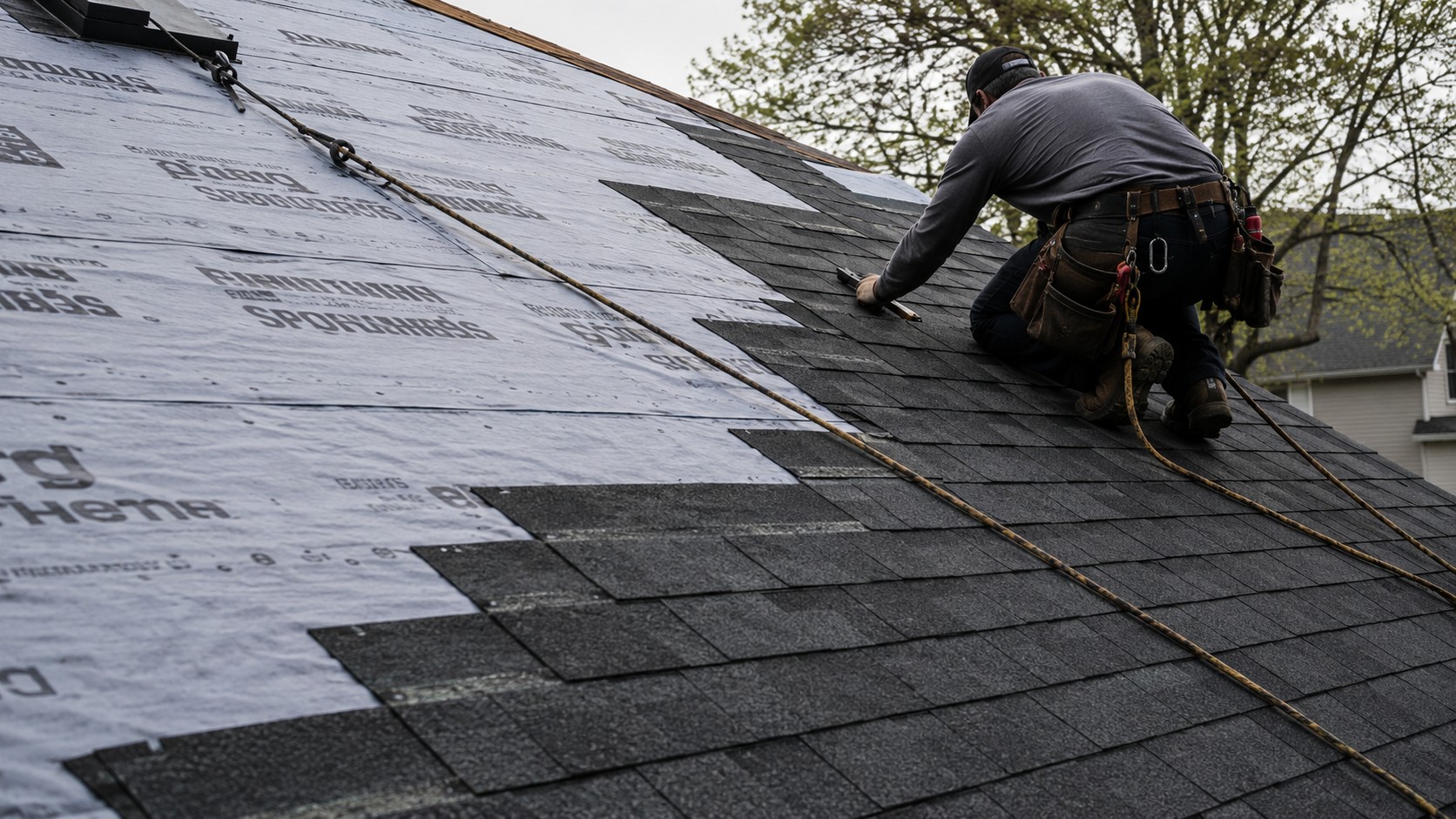
Wheaton's oldest residential neighborhoods surround the historic downtown and Wheaton College campus — bungalows, Craftsman homes, American Foursquares, and a handful of Victorian-era properties. These homes are on their third or fourth roofing system, and every layer has added complexity: original 1.5" board sheathing, multiple historical re-roofing applications creating code-prohibited layers, and chimney flashing that has completed 70–80 freeze-thaw cycles since original installation. Active chimney step and counter flashing failures are the dominant leak source on every block in this zone. Several properties along the Front and Main Street corridors carry Wheaton historic register designation or are adjacent to the DuPage County Historical Museum campus — we confirm designation status at every estimate and carry documentation for approved material alternatives when slate or wood shake originals require replacement with modern equivalents.
The post-war expansion neighborhoods of southern and central Wheaton — Green Valley along Roosevelt Road, Lowell Manor near President Street, and the Hawthorne subdivision south of Geneva Road — represent Wheaton's largest concentration of 1950s and early 1960s ranch homes. These properties are on their second or third roofing system and consistently show the same failure pattern: original builder-grade shingles on shallow 3:12 to 4:12 roof pitches with minimal soffit ventilation that is blocked in nine out of ten homes we inspect. Pipe boot collar failures are endemic in this era — neoprene compounds from 1980s–1990s re-roofing applications have hardened and cracked. The Class 4 impact-resistant shingle economic case is strong in these subdivisions: with minimal roofline complexity, lower installation costs shorten the premium payback period to as little as 3 years with State Farm and Allstate discounts in force.
Wheaton's 1960s and 1970s growth produced a large stock of split-level, raised ranch, and contemporary-style homes in subdivisions scattered across the southern and western portions of the city. Farnham along Naperville Road, Brookshire west of Orchard Road, High Knob east of Orchard near Butterfield, and Pheasant Hollow are the primary examples. Complex multi-level rooflines on split-level homes create valley geometry that is disproportionately vulnerable to ice dam initiation — the junction between the main roof and the lower family room section concentrates meltwater flow precisely at the point where the shallower pitch is least capable of shedding it. We inspect these valley sections explicitly on every Farnham and Brookshire estimate. Many homes in this zone are approaching their second replacement cycle and were re-roofed in the late 1990s or early 2000s, meaning the shingles are 20–25 years old and storm-accelerated regardless of visible wear.
The Danada subdivisions — named for Dan and Ada Rice, developed adjacent to the Danada Forest Preserve — represent Wheaton's largest single-era residential development. Three distinct neighborhoods: Danada East (off Blanchard Road), Danada North (east of Naperville Road near Longfellow Drive), and Danada West (west of Naperville Road) — all built in the 1980s with two-story colonial and Georgian-style homes at varying price points. Original builder-grade architectural shingles from 1985–1995 installations are now at or past their 30–40 year design life, and the 2017 and 2020 hail events have substantially accelerated replacement timelines across all three Danada sections. These homes are the most active replacement market in Wheaton — we completed more Danada projects in 2023 and 2024 than in any other single Wheaton zone. HOA governance in the Danada subdivisions varies by section: Danada North's HOA is more active in enforcing architectural consistency, while Danada East and West have lighter oversight. We confirm current HOA requirements at every estimate.
Wheaton's premium residential corridor spans from the Cantigny Golf Club and Roosevelt Road estate homes through the Marywood custom development (82 homesites, built by Joe Keim Builders, adjacent to the Chicago Golf Club) to the Orchard Estates and Briarcliffe Lakes communities along the western edge of the city. These properties share several common characteristics: high replacement cost values with GAF Golden Pledge® warranty coverage often warranted, complex roofline geometry requiring skilled valley and hip installation rather than cut-and-lay shingle application, and in several cases, National Register proximity or local historic designation through the Cantigny estate corridor. Marywood and the adjacent St. Francis Woods properties along Cantigny Golf Course feature large footprint colonial and traditional homes where replacement projects range from 3,500 to 5,000+ square feet of roof surface — full-day or multi-day projects that require staging coordination. The Briarcliffe Lakes townhome communities have active HOA boards with specific approved material lists and color palettes; we maintain current Briarcliffe Lakes HOA documentation on file for immediate estimate reference.
One Call Gets a Wheaton Crew On Your Roof
Written estimates within 48 hours, GAF Master Elite® certified installation, and a crew that knows Wheaton's permit process cold.
City of Wheaton Roofing Permit Requirements — and One Critical Difference From Other DuPage Cities
The City of Wheaton requires a building permit for all roof replacements, processed through the Building & Code Enforcement Department at 303 W. Wesley Street. All contractors must be registered annually with the City before pulling permits; we maintain current Wheaton contractor registration with all required state licensing documentation on file. On March 1, 2025, Wheaton adopted the 2024 International Residential Code (IRC) and 2023 National Electrical Code, and now requires R-49 attic insulation when installed in the attic — the highest energy code standard in DuPage County currently. We assess insulation R-value as part of every ventilation review on Wheaton replacements.
The most important distinction from other DuPage communities: the City of Wheaton does not require a final inspection on residential re-roofing projects. This is a meaningful difference from Lisle, Naperville, and many neighboring municipalities that mandate post-completion inspections. It means your project timeline in Wheaton is not subject to inspection scheduling delays that can add days or weeks in other jurisdictions. However, the permit itself is still required — and we pull it before any work begins. The permit record protects your position in DuPage County's active resale market, where buyer's attorneys regularly request permit records during due diligence.
We provide all Wheaton homeowners with the Illinois Home Repair and Remodeling Act "Know Your Rights" pamphlet as required by state law, and we include full permit management at no additional charge on every project. For questions about specific project requirements, the Building Department is reached at (630) 260-2050, Monday through Friday, 8 a.m. to 5 p.m.
| Requirement | Wheaton Standard | Our Performance | Why This Matters |
|---|---|---|---|
| Ice & Water Shield | 24" past interior warm wall | Exceeds — full eave coverage standard | Essential on Wheaton's pre-war eaves. |
| Drip Edge | Mandatory — eaves & rakes | Included standard (heavy gauge) | Prevents fascia rot on 70+ year old homes. |
| Final Inspection | NOT required for re-roofing | Faster timeline — no scheduling wait | Unique Wheaton advantage vs. Lisle/Naperville. |
| Contractor Registration | Annual City of Wheaton registration | Current — all docs on file | Verifiable at (630) 260-2050 before signing. |
| Code Standard | 2024 IRC (adopted March 1, 2025) | All installs spec'd to current 2024 IRC | DuPage's newest code — highest R-value standard. |
| Attic Insulation | R-49 in attic per 2024 IRC | Assessed + documented every project | Highest standard in DuPage; protects warranty. |
Wheaton's commercial corridors along Roosevelt Road, Butterfield Road (IL-56), and the Danada Square West and East shopping centers contain a significant number of retail and mixed-use properties with flat and low-slope roof systems. Commercial permits in Wheaton require a separate plan review process through the Building Department with a Plan Examiner review by Bruce Allen at (630) 260-2048. We manage commercial permit applications directly and have completed roofing work on multiple Wheaton commercial properties along Roosevelt and Butterfield. Occupied retail scheduling and tenant coordination are standard scope items on every commercial project we take in Wheaton.
The Most Common Leak Sources in Wheaton — by Construction Era, Neighborhood, and What Other Contractors Miss
More than 400 projects and 20 years of repair calls across Wheaton's five residential eras produces granular pattern recognition. We know what fails first in a College Hill bungalow, what's failing in a Green Valley ranch that last saw work in 1998, and how the Danada colonials are behaving post-2020-storm. That knowledge means we find the actual problem — not just the visible symptom — on the first visit.
Pre-War Downtown & Ranch Era Failures
For Wheaton's oldest homes, the dominant failure sequence is consistent: chimney step flashing fails first at the reglet after 60–80 freeze-thaw cycles; the counter flashing follows within 3–5 years; interior ceiling staining at the chimney breast appears only after both have failed and the underlayment is saturated. In the 1950s ranch stock, neoprene pipe boot collar cracking is epidemic — original or replacement boots from the 1990s have hardened at the stack collar. Valley metal oxidation in standing-seam valley installations from 1980s re-roofing jobs is the third leading active leak source in this era. On every repair call in pre-1970 Wheaton homes, we also check the head flashing at all dormers and skylights — re-sealing rather than proper head flashing replacement is a pervasive historical shortcut that recurs every 3–5 years.
Roof repair servicesDanada & 1980s Colonial Failures
Wheaton's 1980s colonial stock — primarily the Danada subdivisions, Briarcliffe, and the custom homes adjacent to Cantigny Golf — develops a specific failure pattern around pipe boot collars (failing at the standard 15–20 year horizon on installations never replaced at last re-roofing), step flashing at the off-ridge dormers and side walls that are common on Georgian and Colonial elevations, and valley metal that was installed at the correct pitch for the original roofline but has become undersized as ice dam debris has repeatedly impacted the valley at the eave during winter events. For the Danada homes, the specific complication is that many received cosmetic repairs after the 2017 and 2020 storms from contractors who missed the valley metal as an insurance line item. We see recurring leaks at documented 2020-storm-repair locations on Danada properties at a higher rate than anywhere else in our Wheaton service area.
Roof repair servicesWheaton Repair vs. Replace — the Honest Assessment
Wheaton's premium resale market — where median home values are above $475,000 and the Danada subdivisions and Cantigny corridor attract significant buyer interest — makes the repair vs. replace decision more financially consequential than in most suburbs. A roof inspection with a written remaining useful life estimate and condition grading in a DuPage County real estate attorney-accepted format is the single most valuable document a Wheaton homeowner can have at listing time. We have seen Wheaton homes lose $15,000 to $25,000 in net sale price because a buyer's inspector flagged a roof as deferred maintenance without context — and we have seen that same inspection result completely neutralized by a pre-listing written condition report from a credentialed roofing contractor who has inspected the property, documented its current condition, and issued a professional remaining-life estimate. We provide this document at no additional charge on any repair or replacement project, and as a standalone service for homeowners approaching a listing.
Repair vs. replace guideRoofing Services We Provide in Wheaton
Roof Replacement
Full tear-off and replacement across all Wheaton neighborhoods and both ZIP codes. GAF Master Elite® certified crew with Golden Pledge® 50-year warranty available — the only warranty covering both labor and materials for the roof's lifetime. Sized from 1,400 sq ft bungalows to 5,000+ sq ft Marywood custom homes.
Roof Repair
Leak investigation and repair across all Wheaton construction eras — pre-war chimney step flashing, ranch-era pipe boots, split-level valley geometry, dormer head flashing, and colonial-era skylight surrounds. Written repair scope and remaining-life assessment included on every call.
Storm Damage & Claims
Hail and wind damage documentation for Wheaton properties in 60187 and 60189. We attend your adjuster inspection, submit Xactimate-formatted supplements when initial scopes are undervalued, and have experience with all carriers active in the DuPage market — State Farm, Allstate, Farmers, Country Financial, Erie, and USAA.
Asphalt Shingles
Full GAF product line including Timberline HDZ®, Timberline ArmorShield II® Class 4 impact-resistant, and designer series for Wheaton's custom home and historic corridor properties. We carry physical samples and historic district–approved color documentation to every estimate in the pre-1940 zone.
Gutters & Downspouts
Seamless aluminum gutter installation and hail damage replacement. Gutter denting from the 2022 and 2020 events is consistently underpaid in DuPage County insurance claims — we document and include every linear foot in claim scope. Copper gutter options available for Wheaton's historic district properties where original copper profiles require matching.
Roof Inspections
Free 30-point inspections for Wheaton homeowners — post-storm, pre-listing, pre-purchase, and annual maintenance checks. Written condition report with photos, A–F condition grade, and remaining useful life estimate in DuPage County real estate attorney-accepted documentation format. Critical for Wheaton's $475K+ median home market.
What Our Work in Wheaton Actually Looks Like
We've completed over 400 roofing projects in Wheaton since 2005 — from the College Hill bungalows to the Danada colonials and the Cantigny corridor custom homes. These three examples reflect the most common scenarios we manage in the 60187 and 60189 market.
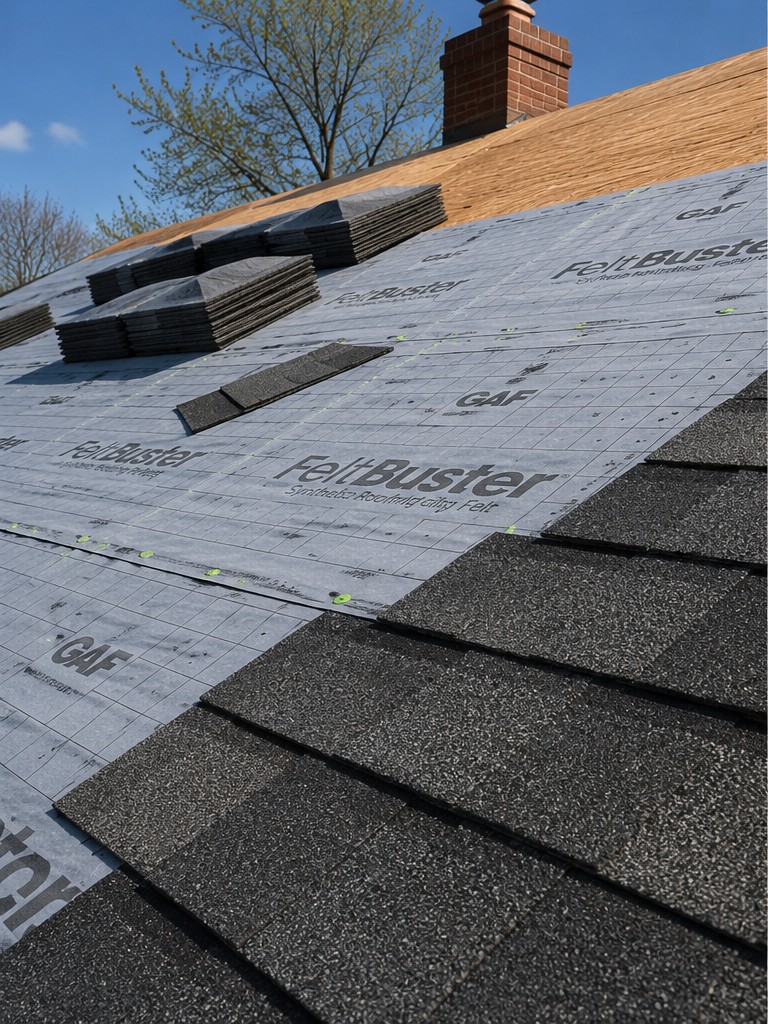
1928 Craftsman bungalow two blocks from Wheaton College. Original Allstate inspection scope had used aerial measurements that missed the actual footprint of the expanded rear addition, excluded the porch roof section entirely as a separate structure (it is not — it is an integral part of the main roof assembly under Illinois roofing law), and classified the granule displacement on the 2003 architectural shingle layer as "wear, not functional damage." We documented 67 functional hail strikes across five roof planes, submitted supplemental Xactimate scope using HAAG Engineering methodology, and successfully argued the porch inclusion through Allstate's supplemental review. Final approved scope was $6,400 above the initial estimate. Because this home had a discontinued shingle profile — the 2003 Owens Corning Oakridge pattern is no longer in production in the same dimension — the Illinois Matching Law required Allstate to fund a full replacement across all connected roof sections. Total homeowner out-of-pocket: deductible only.
Danada East colonial with original 1988 installation shingles — re-roofed in 2003, then storm-damaged in 2022. State Farm's initial estimate was $2,900 below our measured scope — aerial satellite had undercounted by 320 square feet on a home with a bump-out addition off the kitchen that created a non-standard roof plane. We also flagged the fascia and all gutters as hail-damaged (32 impact points across 180 linear feet of aluminum) — State Farm had included zero fascia and only 60 LF of gutter. After supplement submission and adjuster re-inspection with our team present, the revised scope covered the full replacement plus a Class 4 ArmorShield II® upgrade. The homeowner's State Farm premium for the wind/hail rider dropped $420 per year at renewal — a 26% reduction. Payback on the Class 4 upgrade premium: 4.1 years, after which the annual savings continue for the life of the roof. GAF Golden Pledge® 50-year warranty issued.
Green Valley ranch homeowner had dealt with a north-eave ice dam and ceiling stain above the dining room for four consecutive winters. Two previous contractors had patched the roof surface without addressing the underlying cause. We performed a ventilation net free area calculation and found that the attic was operating at 1:340 — less than half the minimum 1:150 required by Illinois code at the time of the last re-roofing. The three soffit panels on the north elevation had been sealed during a 1978 foam insulation retrofit and had not been reinstated. We reopened and screened the blocked soffit intakes, installed a 12-foot continuous ridge vent section, replaced the pipe boot collar that had cracked at the stack (the secondary leak path masked by the ice dam), and re-adhered the ice-and-water shield tab at two eave locations where the original installation had delaminated. Total cost: $1,480. The ice dam has not recurred in the two subsequent winters. The homeowner subsequently received a $380/yr premium reduction from Country Financial for a ventilation certification we provided with the repair documentation.
What Wheaton Homeowners Say
Verified Google reviews from Wheaton, IL homeowners. See all 312+ reviews →
"We have a 1928 Craftsman on Franklin Avenue and were nervous about finding a contractor who understood older homes and the Allstate claim process simultaneously. Naperville Roofing Crew did both better than we expected — they got our claim supplemented by over $6,000, applied the Illinois Matching Law to get our porch roof covered, and replaced everything without a single issue with the permit process. The crew was back the next day for a touch-up and didn't leave until it was right."
"Our Danada East colonial was hit in the July 2022 storm and State Farm came back with an estimate that felt low. Naperville Roofing Crew measured the actual roof — not satellite data — found the missed footage and gutters, and got the supplement approved. We ended up upgrading to the Class 4 shingles and our State Farm premium dropped $420 a year. They told us upfront it would take 4 years to pay back the upgrade cost, and the math was exactly right. Highly recommend for anyone dealing with a Wheaton storm claim."
"I had an ice dam stain in the same corner of my dining room for four winters. Two roofers patched and re-patched. Naperville Roofing Crew came out, calculated the actual ventilation ratio in my attic, showed me exactly which soffit panels were sealed, and fixed the real problem. $1,480 total. That was 18 months ago and the north eave has been perfectly dry through two full winters. They also gave me a written report that got me a premium discount from Country Financial I didn't even know to ask for."
Roofing FAQ for Wheaton Homeowners
Does Wheaton require a permit to replace a roof — and is there a final inspection?
Yes to the permit — no to the final inspection. The City of Wheaton requires a building permit for all roof replacements, processed through the Building & Code Enforcement Department at 303 W. Wesley Street (phone: 630-260-2050). The permit fee is calculated based on the stated value of the construction project, so exact costs vary by roof size and material. However, Wheaton explicitly does not require a final inspection on residential re-roofing projects — a meaningful difference from Lisle, Naperville, and other DuPage municipalities that mandate post-completion inspections. This means your Wheaton project timeline is not subject to inspection scheduling delays. All contractors working in Wheaton must be registered annually with the City before pulling permits — we maintain current registration and pull the permit before any work begins. The permit record is still important documentation for DuPage County resale transactions: buyer's attorneys routinely check permit records as part of due diligence, and unpermitted work surfaces as a required disclosure item. We include permit management at no additional charge on every project.
How much does roof replacement cost in Wheaton?
Wheaton has the broadest replacement cost range of any community we serve — driven by the 100-year spread in housing stock. A straightforward Green Valley or Lowell Manor ranch (1,600–2,000 sq ft, simple 4:12 pitch, minimal penetrations) typically runs $10,000–$14,000 with GAF Timberline HDZ® architectural shingles including permit, tear-off, ice-and-water shield, and all flashings. A Danada East or West colonial (2,600–3,200 sq ft, moderate complexity) runs $16,000–$22,000. Custom homes in Marywood, Cantigny corridor, or Orchard Estates with complex geometry and larger footprints range from $24,000 to $40,000+. The GAF Golden Pledge® 50-year warranty, which covers both labor and materials, is available on all replacement projects and recommended for Wheaton's premium resale market. For storm-damage replacements, insurance typically covers replacement cost value less your deductible if you have an RCV policy — and we attend your adjuster inspection to ensure the scope is correctly documented. See our 2026 DuPage County Roof Replacement Cost Guide for current Xactimate line-item pricing.
My Wheaton home is in the historic district or near Wheaton College. Does that affect my roofing options?
It may, depending on whether your property is listed on the Wheaton Register of Historic Places or is in the vicinity of the National Register-listed Cantigny estate corridor. The City of Wheaton Historic Commission administers the Wheaton Register program, which does not automatically impose material restrictions on re-roofing — but properties formally designated as Wheaton Register landmarks may be subject to review by the Historic Commission before exterior material changes are made. National Register properties (principally the Cantigny Victorian homes along Roosevelt Road) require a more formal Section 106 review process if federal funds are involved, but private homeowner replacements with private funds on National Register properties do not require federal approval. We confirm your property's designation status before every estimate in the pre-1940 zone. For properties with historic designation, we carry documentation for approved material substitutions — including modern architectural shingles that replicate slate and wood shake profiles at a fraction of the cost and with better storm resistance. The Wheaton Historic Commission is reached through City Hall; we have the current contact information at every estimate visit.
What building code does Wheaton currently use for roofing — and what changed in 2025?
On March 1, 2025, the City of Wheaton adopted the 2024 International Residential Code (IRC) and 2023 National Electrical Code — making Wheaton one of the first DuPage County municipalities to implement the 2024 standards. The most consequential change for roofing: the Illinois Energy Conservation Code now mandates R-49 attic insulation when insulation is installed in the attic, and R-30 when entirely above the deck. This is higher than the previous standard and is particularly relevant for Wheaton's older housing stock, where existing insulation in many homes falls substantially below R-49. While existing homes are not required to retrofit to R-49 at re-roofing (unless the building official specifically requires it as part of code compliance review), the new standard is worth understanding in the context of your attic's current condition. We assess existing insulation R-value at every estimate and include a written disclosure of the current versus code-required value. If correction is appropriate — particularly for Wheaton's ice dam-prone pre-1970 homes — we include a ventilation and insulation correction plan in the re-roofing proposal.
Is it worth upgrading to Class 4 impact-resistant shingles in Wheaton?
For most Wheaton homeowners, yes — particularly in the Danada subdivisions, Briarcliffe, and the post-war ranch zones where roofline simplicity keeps installation cost increments lower. GAF Timberline ArmorShield II® Class 4 shingles typically add $1,500–$4,000 to a standard Wheaton replacement depending on roof size and complexity. State Farm, Allstate, and Farmers offer premium discounts of 20–30% on the wind/hail portion of the homeowners policy for certified Class 4 roofs — on a typical Wheaton homeowners policy (higher than average due to higher home values), that can represent $350–$600 in annual savings. Payback on the upgrade cost is commonly 4–7 years. Class 4 shingles also improve your claims history profile going forward, which matters in DuPage County's active storm market. We run the specific payback calculation against your current policy premium at every estimate. For Wheaton's custom home zone — Marywood, Cantigny corridor — the Class 4 economics are also favorable but secondary to the GAF Golden Pledge® warranty, which provides the most comprehensive labor and material coverage available. Read our detailed Illinois insurance and Class 4 guide for carrier-specific discount details.
How do I know if my Wheaton roof has hail damage after a storm?
Functional hail damage — the type that qualifies for an insurance claim — is invisible from the ground. It appears on the roof surface as granule displacement and fiberglass mat fracture at the impact point, which registers as a dark bruise with displaced granules under the mat when examined up close. The most reliable ground-level indicator is impact denting on aluminum gutters, fascia, AC condenser fins, and window screen frames. Soft metals dent at approximately the same hail size threshold that causes functional shingle damage — 1.0" to 1.25" diameter at 25–35 mph impact velocity for most architectural shingle products. If you observed hail during the event and can see visible impact marks on any soft metal surface, a professional inspection is warranted. For the July 2022 and August 2020 events specifically — both of which affected central Wheaton — the claim filing window under most DuPage County policies is typically 1 year from the storm date for new claims and 1–2 years from initial settlement for supplement and recoverable depreciation claims. A free post-storm inspection is the only method to generate documentation sufficient for a DuPage County insurance claim.
My Danada home had a repair done after the 2020 storm and is leaking again. What's happening?
This is the single most common repair call we receive from Danada homeowners — and we see it at a higher rate in Danada East and West than anywhere else in our service area. After the 2020 storm, many Wheaton homeowners received cosmetic storm repairs from contractors who identified and patched the visually obvious damage — missing shingle tabs, lifted flashings — but missed the secondary damage that requires careful inspection: valley metal that received direct hail impact and developed micro-fractures in the sealant line that don't produce active leaks immediately but fail over the next 2–3 winters; dormer cheek flashing that was properly installed originally but whose lap joint was jarred loose by the impact of large debris and is now wicking water laterally into the wall assembly; and pipe boot collars where the primary seal was stressed by the storm and is failing progressively rather than suddenly. On every Danada repair call that follows a 2020 or 2022 storm repair, we perform a complete re-inspection rather than simply addressing the reported symptom. In most cases we find a secondary failure point within 18 inches of the location that was previously repaired.
Does my Wheaton home's HOA have roofing requirements I need to follow?
Wheaton's HOA landscape varies significantly by subdivision. In the Danada subdivisions, Danada North's HOA is the most active in enforcing architectural consistency — material and color approval is typically required before work begins, and we submit the required documentation directly to the HOA board on your behalf. Danada East and West have lighter oversight but still require notification of exterior work. The Briarcliffe Lakes townhome communities have active HOA boards with specific approved material lists; we maintain current Briarcliffe Lakes approved product documentation on file. Marywood is a Joe Keim Builder community with HOA deed restrictions on exterior materials — we have completed projects in Marywood and are familiar with the applicable deed restriction language. If you are in one of Wheaton's older, non-HOA subdivisions (Green Valley, Lowell Manor, Hawthorne, Farnham, Brookshire), no HOA approval process applies — only the City of Wheaton permit requirement. We confirm your specific HOA governance at every estimate before any documentation is submitted or work begins.
How do I find a reputable roofing contractor in Wheaton?
Five verifiable steps before signing anything: (1) confirm current contractor registration with the City of Wheaton Building Department at (630) 260-2050 — registration is required annually and is publicly verifiable; (2) request a certificate of insurance naming your property address specifically; (3) confirm they pull a City of Wheaton permit before starting — even though Wheaton doesn't require a final inspection, the permit itself is still required and its absence creates resale disclosure complications; (4) for pre-war or historic-adjacent properties, confirm they have experience with Wheaton historic register designation and know when to consult the Historic Commission; (5) for any storm claim, confirm they attend adjuster inspections in person — contractors who submit claims remotely without on-site adjuster presence consistently produce lower approved scopes. Beyond verification: look for local Wheaton-specific Google reviews that reference the same neighborhood as your home, not just generic suburb reviews. A contractor with 20 reviews from Danada homeowners knows Danada — a contractor with generic DuPage reviews may not.
Request a Free Estimate in Wheaton
We've been active across all of Wheaton since 2005 — from the College Hill bungalows to the Danada colonials and the Cantigny corridor custom homes. Over 400 completed projects in 60187 and 60189 gives us neighborhood-by-neighborhood knowledge no contractor new to Wheaton can replicate. On-site assessment, written itemized proposal within 48 hours, City of Wheaton permit management included.