Roofing Contractor
Oswego, IL
- policy-specific shingle matching (Illinois has no statewide matching statute): 60543 homes from the 1995–2010 boom era frequently carry discontinued builder-grade shingle profiles — often qualifying for full insurance-funded replacement.
- Code Compliance: Strict adherence to Village of Oswego 2021 IRC (Village of Oswego; confirm parcel jurisdiction for unincorporated areas) locally amended building codes and Community Development Department permit requirements.
- HOA Approvals: Records of approved palettes for WaterBrook, Fox Chase, and Hudson Crossing already on file.
Oswego was one of the fastest-growing communities in the entire United States during the 2000s — a village of roughly 3,000 people in 1990 that grew past 30,000 within two decades. That growth means the vast majority of Oswego's housing stock was built during a single 20-year construction window, and thousands of those roofs are now entering their first replacement cycle at nearly the same time. We've worked across the historic downtown along the Fox River, the older Boulder Hill subdivision, and every wave of the western growth corridor across the local service area.
Kendall County Sits Squarely in the Same Storm Corridor That Hits Naperville and Plainfield
Oswego's flat terrain along the Fox River provides no topographic buffer from the supercells that track northeast across the Chicago metro. NOAA storm event data for the Kendall/Will County border documents recurring hail activity — the June 2020 outbreak dropped hail across the Route 34 corridor, the August 2020 Derecho produced straight-line wind damage that hit the entire village simultaneously, and the July 2022 event concentrated damage along the western growth corridor near WaterBrook and Fox Chase.
Because so much of Oswego's housing stock was built in the same 15-year window, a single storm event can generate claims activity across an entire subdivision at once — and because many of those homes share the same builder-grade shingle profile, a discontinued-product finding on one house is a strong signal for every home on the block under the policy-specific shingle matching (Illinois has no statewide matching statute). We cross-reference NOAA records on every inspection and attend every adjuster visit in person.
How we manage Kendall County hail & wind claimsOswego homeowners affected by the 2020 or 2022 events may still have actionable insurance claims depending on carrier and policy type. RCV policies that issued depreciation holdbacks at original claim settlement may have open recoverable depreciation that can still be collected after a completed replacement. Request a free post-storm inspection and policy review.
Ice Dam Risk Varies More by Construction Era in Oswego Than Almost Anywhere Else We Serve
Ice dams form when attic heat loss melts snow on the upper roof plane. Meltwater runs to the cold eave overhang, refreezes, and builds a ridge that blocks subsequent drainage — and because Illinois code only requires ice-and-water shield 24" past the interior warm wall, water traveling further up the eave encounters unprotected decking. Because Oswego's housing stock is so heavily concentrated in a single 15-year construction window, ice dam risk here tracks builder era more predictably than in older, more architecturally mixed communities.
Boulder Hill's older ranch-style homes — many originally built as summer cottages before year-round conversion — frequently have shallow attic cavities and minimal original ventilation. The 1995–2010 boom-era subdivisions along the western growth corridor generally have better builder-grade ventilation, but two-story Colonials with cathedral ceiling sections still create localized cold spots. Every re-roofing estimate we provide in Oswego includes a formal attic ventilation assessment at no additional charge.
Schedule a winter damage assessmentOriginally platted as a summer-cottage community along the Fox River before widespread year-round conversion. Shallow attic depth, minimal original ridge ventilation, and decades of ad hoc additions. Ice dam events are nearly annual in cold winters on unmodified homes.
Generally better-ventilated due to post-1993 Illinois code requirements, but two-story Colonials with cathedral ceiling sections and bonus-room bump-outs still generate localized cold spots. Volume-builder ventilation packages from this era are functional but rarely exceed code minimum.
Newer construction under stricter ventilation code generally performs well. Pipe boot cracking and ridge cap wind exposure are the more common cold-weather failure points in this era rather than ice damming.
Insurance note: Ice dam damage is covered under most Illinois HO-3 policies as a sudden water damage peril. However, a carrier can deny a repeat ice dam claim if the underlying ventilation deficiency was identified in a prior claim and not remediated. We document both the damage and the ventilation condition in every assessment to protect your future claim eligibility.
One ZIP Code. Three Distinct Waves of Construction.
No community in our service area grew faster or more concentrated in time than Oswego. A Boulder Hill ranch and a Prestwick two-story Colonial are separated by 50 years of construction standards, entirely different permit histories, and radically different failure modes — despite sharing the same ZIP code. We know all three eras, and we price accordingly.
Pre-1970 Fox River Corridor
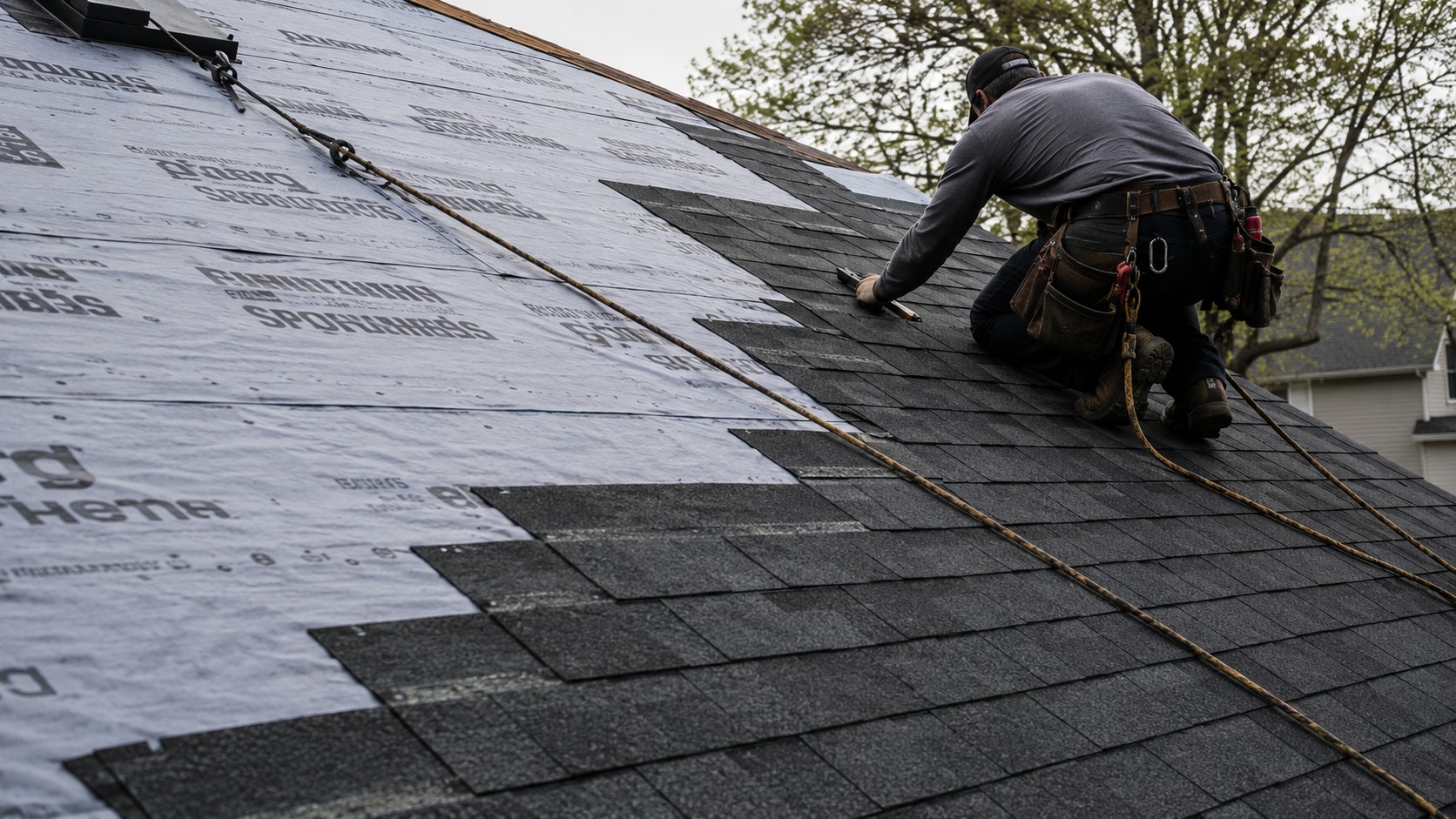
Boulder Hill was originally developed as a summer-cottage community along the Fox River before converting to year-round housing in the mid-20th century, and today it's one of the largest unincorporated-turned-annexed residential areas in Kendall County. Combined with the small historic core along Main and Washington Streets downtown, this is Oswego's oldest and most architecturally varied housing stock — original board decking, ad hoc additions, and multiple stacked shingle layers are common.
Avg. replacement: $9,500–$15,000
1995–2010 Boom Era (Dominant)
This is the era that built modern Oswego — the fifteen-year stretch when the village's population grew roughly tenfold. WaterBrook, Fox Chase, Hudson Crossing, Deer Run, and dozens of similarly-sized subdivisions produced high volumes of two-story Colonials on a compressed timeline. Most of these roofs are now 15–30 years old and entering their first full replacement window at nearly the same time, and many carry discontinued builder-grade shingle profiles.
Avg. replacement: $8,000–$23,000 (illustrative planning range for a typical 15–27 square home at $550–$850/square; quote depends on roof size, pitch, layers, and deck condition)
2005–Present Newer Builds
Oswego's newest residential tier, including the Prestwick golf course community, is not yet at end-of-life on original shingles, but higher home values and I-88/Route 34 wind exposure make these homes the strongest candidates in the village for Class 4 impact-resistant shingle upgrades — the insurance premium payback is typically fastest here given the larger insured values involved.
Avg. replacement: $14,000–$21,000
One Call Coordinates a Vetted Oswego Roofing Crew
Written estimates within 48 hours, vetted, IDFPR-licensed Illinois roofing, and a crew that knows Oswego's permit process cold.
Village of Oswego Roofing Permit Requirements
The Village of Oswego requires a building permit for all roof replacements through the Community Development Department. Applications are processed through the Village's permit portal, and standard residential roofing permits are typically approved within 5–7 business days. Contractors must carry current registration and contractor registration and insurance verified before work begins— we maintain active Oswego registration for same-day submission.
Oswego has adopted the 2021 International Residential Code with local amendments. Ice-and-water shield, drip edge, and a final inspection are all required on every full replacement. Permit fees for residential roofing typically fall in line with other Kendall/Will County municipalities — we include the fee in every written estimate and handle the full permit and inspection process at no additional charge.
| Requirement | Village Standard | Our Performance |
|---|---|---|
| Ice & Water Shield | 24" past interior warm wall | Exceeds — full eave coverage standard |
| Drip Edge | Mandatory — eaves & rakes | Included standard (heavy gauge) |
| Final Inspection | Required — Village of Oswego | code-compliant permit coordination · Managed directly |
| Contractor Registration | Current insurance certs on file | Current — portal ready |
| HOA Pre-Approval | Required where applicable | Handled · known committees on file |
The Most Common Leak Sources in Oswego Homes — by Construction Era
Fifteen years of repair calls across Oswego's construction eras produces consistent patterns — faster diagnoses, more accurate repair scopes, less unnecessary work.
Boulder Hill (Pre-1970)
Chimney flashing failures and stacked shingle layers are the leading issues — many homes have been re-shingled twice without a full tear-off, which creates code violations and hidden deck damage that surfaces only during the next replacement.
1995–2010 Boom Era
Pipe boot cracking and ridge cap lifting dominate repair calls in WaterBrook, Fox Chase, and Hudson Crossing. Builder-grade materials from this era are at or past rated lifespan, and many profiles are discontinued — a Matching Law flag on any storm claim.
Prestwick & Newer Builds
Wind-uplift exposure along the Route 34 corridor is the main concern — hip and ridge cap failures after high-wind events are the most frequent repair call in this newer tier of homes.
Roofing Services We Provide in Oswego
Roof Replacement
Full tear-off across every Oswego era — Boulder Hill ranches to Prestwick two-stories. applicable manufacturer and contractor workmanship warranties available.
Roof Repair
Chimney flashing, pipe boots, ridge cap, and valley repair — matched to your home's construction era. Same-week scheduling.
Storm Damage & Claims
NOAA-verified documentation, adjuster meetings, and Matching Law research for Kendall County hail and wind claims.
Asphalt Shingles & Class 4
Full GAF product line including Class 4 ArmorShield II — strongest ROI in Oswego's newer, higher-value subdivisions.
Gutters & Downspouts
Seamless aluminum gutters sized correctly for Fox River-corridor drainage — undersized 5" gutters are a common builder-grade shortcut we correct.
Roof Inspections
Free inspections — post-storm, pre-listing, or annual maintenance. Written condition report with photos and remaining useful life estimate.
Local Scope & Project Coordination Standards in Oswego
We coordinate residential and commercial roofing projects in Oswego with vetted, independently licensed and insured Illinois roofing professionals. The assigned contractor performs the inspection, pulls any required permits, and provides a written scope before work begins.

1. Tear-Off, Deck & Ventilation Spec
Assigned crews inspect roof decking after tear-off, follow adopted IRC layer limits, and specify cold-climate ice barrier (at least 24 inches inside the exterior wall line), drip edge, and balanced intake/exhaust ventilation.
2. Oswego Permit & Parcel Verification
Where a permit is required in Kendall County, the assigned licensed contractor pulls it and schedules required municipal or county inspections. Always confirm permit authority by parcel or tax bill and complete any HOA review before installation.
3. Written Estimates & Storm Records
Contractors document physical roof condition and provide an itemized written estimate. Per Illinois law (815 ILCS 513/18), homeowners pay their deductible; coordinators and contractors do not negotiate insurance claims (use a licensed public adjuster or attorney).
What to Verify Before Any Oswego Roof Work Starts
Clear scope, state license verification, and written contractor terms before work begins. Schedule a free roof inspection →
IDFPR License & Insurance
Verify the assigned contractor's Illinois roofing license (225 ILCS 335) on the IDFPR lookup before signing, and request certificates for state-required liability, bonding, and workers' compensation.
Illustrative Planning Ranges
Published regional estimates indicate architectural asphalt replacement runs roughly $550–$850 per square installed (about $8,000–$23,000 for a typical 15–27 square home). Your quote depends on roof size, pitch, layers, deck condition, and the assigned contractor's scope.
Written Scope & Warranty Clarity
All installation, permitting, and workmanship or manufacturer warranties are provided by the assigned contractor and manufacturer terms—confirm tear-off, ice barrier, flashing, and cleanup details in writing.
Roofing FAQ for Oswego Homeowners
Do I need a permit to replace my roof in Oswego?
Yes. The Village of Oswego requires a building permit for all roof replacements through the Community Development Department, processed via the Village's permit portal. Standard applications are typically approved within 5–7 business days, and contractors must have current registration and insurance certificates on file before a permit is issued. We include permit and final inspection management at no additional charge on every project.
My home is in WaterBrook, Fox Chase, or another HOA community — does that affect my roofing options?
Many of Oswego's boom-era subdivisions maintain active homeowner associations with shingle color and profile requirements. WaterBrook, Fox Chase, and Hudson Crossing all require pre-approval before a permit is filed — we verify your specific HOA's current approved list and submit on your behalf at no added charge. Communities in the newer 2005+ tier, like Prestwick and Autumn Creek, generally have similar architectural review processes.
How much does roof replacement cost in Oswego?
Costs vary by era: Boulder Hill ranches typically run $9,500–$15,000. The dominant 1995–2010 boom-era two-story Colonials (WaterBrook, Fox Chase, Hudson Crossing) typically run $8,000–$23,000 (illustrative planning range for a typical 15–27 square home at $550–$850/square; quote depends on roof size, pitch, layers, and deck condition). Newer Prestwick, Autumn Creek, and Windcrest homes typically run $14,000–$21,000 given larger footprints. These are 2026 figures for standard GAF architectural shingles — see our full cost guide for a line-item breakdown.
My builder-grade shingles are discontinued — can I use the policy-specific shingle matching (Illinois has no statewide matching statute) to get a full replacement?
Potentially yes, and this is especially relevant in Oswego because so much of the housing stock shares the same builder-grade shingle profiles from the 1995–2010 construction boom. Under 215 ILCS 5/155.04, if a repair can't reasonably match undamaged adjacent material, your insurer must cover full-plane or full-roof replacement instead. We research manufacturer availability as a standard part of every storm-damage claim. See our full policy-specific shingle matching (Illinois has no statewide matching statute) guide.
Is my Boulder Hill home likely to have too many shingle layers for an overlay?
Often, yes. Boulder Hill's older housing stock has frequently been re-roofed more than once without a full tear-off, and most building codes cap installations at two shingle layers maximum. A third layer requires mandatory tear-off before new shingles can be installed — a contractor quoting an overlay without checking layer count first is quoting work that may fail inspection. We count layers at every Boulder Hill estimate.
Is a Class 4 impact-resistant shingle worth it for my Oswego home?
For most Oswego homeowners, yes — particularly in the newer, higher-value Prestwick and Autumn Creek subdivisions where larger insured home values translate to larger absolute premium savings. Class 4 shingles typically cost 15–20% more upfront but earn a may offer carrier- and policy-specific discounts (not automatic or guaranteed—ask your carrier) wind/hail premium discount from most Illinois carriers, with payback commonly in the 4–6 year range. See our materials guide for the full comparison.
Request a Free Estimate in Oswego
We've served Oswego homeowners since the village's growth boom — local residential and commercial projects across Boulder Hill, the 1995–2010 subdivisions, and every newer development since. On-site assessment, written itemized proposal within 48 hours, Village permit and HOA documentation handled by our team.