Romeoville's Verified
Storm History
Romeoville is home to the National Weather Service Chicago forecast office on Romeo Road — the agency responsible for issuing every severe thunderstorm warning, tornado watch, and winter storm advisory for the entire six-county Chicago metro. It is, fittingly, one of the most storm-documented communities in Will County. Doppler radar has detected hail at or near Romeoville on 86 occasions, with 13 confirmed on-the-ground spotter reports. The village sits directly on the I-55 storm corridor, and the flat terrain of what was once the glacial Lake Wauponsee basin offers no topographic protection from supercells tracking northeast from central Illinois.
Every event below appears in the NOAA Storm Events Database. We reference this data in every Xactimate insurance claim file we prepare — it is the same documentation the National Weather Service, insurance carriers, and independent adjusters use to verify damage dates and severity.
| Date | Event | Hail / Wind | Area Impacted | Severity |
|---|---|---|---|---|
| Aug 2020 | Derecho | 65+ mph winds | Village-wide; worst along Weber Rd / I-55 corridor | MAJOR |
| Jun 2024 | Hail & High Wind | 1.75" (NBC-verified) | Will County-wide; Romeoville / Darien confirmed | HIGH |
| Jul 2022 | Hail & Thunderstorm | 1.50" | Central Romeoville; Weber Rd / Taylor Rd zone | HIGH |
| Jun 2020 | Hail | 1.75" | South Romeoville; Fieldstone / 135th St corridor | HIGH |
| Jun 2017 | Hail | 1.50" | North Romeoville; Hampton Park / Rt 53 area | MODERATE |
| May 2013 | Hail & Wind | 1.50" | Will County-wide; Wesglen / Weslake corridor | MODERATE |
The National Weather Service Chicago forecast office, located at 333 W. University Drive on the Lewis University campus in Romeoville, issues all severe weather warnings for northeastern Illinois and northwestern Indiana. Romeoville is therefore, literally, at the center of the country's most rigorously documented storm-tracking region. Every hail event, every wind gust, every tornado warning in the six-county Chicago metro is logged and archived by the office operating in your community. When we present NOAA storm data to your insurance adjuster, we're citing the agency that tracked the storm from the building on your neighbor's street.
Ice Dam Risk by
Romeoville Neighborhood
Ice dam risk in Romeoville is concentrated in two zones: Hampton Park's original prefab homes (inadequate attic depth and ventilation from the 1957–1970 construction era) and the early Weber Road Colonials (1987–1999) where volume-builder ventilation packages were minimal.
One ZIP Code.
Three Generations of Rooflines.
Romeoville grew in three distinct waves — and each left behind a different roofing profile. Your home's failure modes, shingle options, and permit requirements all depend on which era built your block.
1957–1970 Alexander Prefab Era
Hampton Park was Romeoville's founding subdivision — 600 acres of farmland converted to housing starting in 1957. Alexander Construction Company's prefabricated homes were assembled at a rate of ten per day, with roof trusses installed in hours. The neighborhood housed 12,000 residents by 1970 and remains the densest residential zone in the village. These are ranches and raised ranches, typically 900–1,600 sq ft, with low-pitch rooflines, minimal attic depth, and no original ridge ventilation. Many have been re-roofed once; some carry stacked shingle layers from multiple re-roofs. Over 12,000 Romeoville residents still call Hampton Park home.
Primary failure: Stacked shingle layers (max 2 per code), no ridge vent, blocked soffits, ice dam infiltration
Critical check: Two-layer limit — if three layers present, full deck tear-off is mandatory
Avg. replacement: $9,500–$14,000 (ranch footprint, with ventilation correction)
1987–1999 Mid-Village Revival
No new home permits were issued in Romeoville between 1979 and 1987. Pine Trails restarted the engine, followed by Poplar Ridge, Lakewood Estates (McBoy & Sarsfield Construction), Honeytree townhomes, and Heritage Place (Neumann Homes). These 1987–1999 homes are now 25–38 years old — squarely at or past the end of original architectural shingle lifespan. The builder-grade profiles from this era (predominantly Owens Corning and Certainteed products from the early 1990s) have been largely discontinued, which means documented storm damage to any slope typically triggers policy-specific shingle matching (Illinois has no statewide matching statute) full-replacement coverage.
Primary failure: End-of-life granule loss, failed pipe boots, cracked ridge cap, inadequate ventilation baffles
IL Matching Law: 1990–1998 builder profiles from this era are predominantly discontinued
Avg. replacement: $8,000–$23,000 (illustrative planning range for a typical 15–27 square home at $550–$850/square; quote depends on roof size, pitch, layers, and deck condition)
1995–2005 Western Expansion Boom
The I-55/Weber Road interchange opened in October 1990, and within five years the west side of Romeoville was transforming into the village's premier residential tier. Wesglen (Neumann Homes) and Weslake (1995–2003) are the flagships — larger two-story Colonials and neo-eclectic homes on generous lots, many backing to ponds. Both communities have active HOAs with architectural review requirements. Wesglen is centered around the Wesglen Country Club; Weslake features the Weslake Country Club. Homes built 1995–2003 are entering their first full replacement cycle; 2000–2005 builds have 5–10 more years on original shingles but are frequently caught in storm-related first claims.
HOA process: Architectural review required before permit — color palette pre-approval by association
Primary failure: Hip ridge cap wind uplift (I-55 exposure), pipe boot cracking, valley shingle wear on north slopes
Avg. replacement: $14,500–$21,000
2005–Present Newer Builds
Southwest Romeoville's newest residential tier — Fieldstone-Mistwood (Pasquinelli, mid-2010s), Renwick Place (D.R. Horton and Olthof Homes, 2018+), and Lakewood Falls (early 2010s) south of Lockport Road. These homes are not yet at end-of-life on original shingles but are increasingly filing storm damage claims from the 2020 and 2022 events. This is the optimal zone for Class 4 impact-resistant shingle upgrades: the replacement cost premium is modest, the I-55 corridor wind exposure means Class 4's structural advantage is realized faster, and insurance premium reductions on newer higher-value homes are the largest in the village.
Class 4 upgrade ROI: Best in Romeoville — wind exposure + newer higher home values = fastest premium payback
Primary failure: Storm damage from 2020/2022 events, pipe boot cracking, ridge cap exposure
Avg. replacement: $15,000–$24,000
One Call Coordinates a Vetted Romeoville Roofing Crew
Written estimates within 48 hours, vetted, IDFPR-licensed Illinois roofing, and a crew that knows Romeoville's permit process cold.
Romeoville Roof Permits:
What You Need to Know
The Village of Romeoville requires a permit for most home improvements, including all roofing work. The Building Division at Village Hall (1050 W. Romeo Road) coordinates all permits and on-site inspections. A key Romeoville-specific requirement: all contractors must be registered and bonded with the Village before any permit is issued. Unregistered contractors cannot pull permits — and a roof installed without a permit creates complications at sale and voids most manufacturer warranties.
Inspection scheduling requires 72-hour advance notice (call 815-886-7200 or email the Building Division). Inspections are scheduled on a first-come, first-served basis. Construction is permitted Monday–Friday 7 AM–8 PM and weekends 8 AM–6 PM.
Building code limits asphalt shingle installations to two layers maximum. Many Hampton Park homes built in 1957–1970 and re-roofed in the 1980s and again in the 2000s now carry three layers — which requires a full tear-off before any new shingles can be applied. We identify layering as part of every Hampton Park estimate. A contractor who quotes "overlay" pricing on a three-layer Hampton Park roof is quoting work that will fail inspection.
Romeoville Roof Repair
by Construction Era
1957–1970
Alexander Prefab Ranches
Hampton Park's prefabricated ranches are the oldest and most architecturally uniform homes in Romeoville. Built for speed and affordability, not longevity — the original roof assemblies had no ridge vent, no soffit ventilation, and minimal insulation depth. Homes that have been re-roofed without addressing the underlying ventilation continue to suffer ice dams, premature shingle failure, and moisture accumulation in the deck. Many now carry two or three shingle layers. A contractor who doesn't probe for layer count before quoting is setting up an inspection failure.
1987–2003
Post-Freeze & Weber Rd Boom
Eight years without a single new home permit, then a decade of non-stop construction. Pine Trails, Poplar Ridge, Lakewood Estates, Wesglen (earliest phases), Heritage Place, and the first Weslake sections all come from this era. Builder-grade three-tab and early architectural shingles from Owens Corning and Certainteed installed 1987–2003 are at or past their rated lifespan. Many profiles have been discontinued. This is the sweet spot for policy-specific shingle matching (Illinois has no statewide matching statute) — documented storm damage to any slope can convert a partial claim into a full-replacement payout because the matching product no longer exists.
2003–Present
Fieldstone, Renwick & New Build
The newest tier of Romeoville construction — Fieldstone-Mistwood (Pasquinelli), Renwick Place (D.R. Horton/Olthof), and Lakewood Falls — are not at end-of-life on original shingles. But these homes are in Romeoville's most wind-exposed zone, adjacent to I-55 and the Renwick Road corridor, and storm claims from the 2020 and 2022 events generated significant activity here. This is also the strongest Class 4 upgrade market in Romeoville: newer homes with higher insured values generate the largest absolute premium reductions, and the I-55 wind exposure means impact resistance delivers real protection.
Every Service Romeoville
Homeowners Need
Roof Replacement
Full tear-off and replacement for every Romeoville era — Hampton Park prefab ranches, Weber Road Colonials, and Wesglen two-stories. applicable manufacturer and contractor workmanship warranties warranty available. Village permit filed and registered-contractor requirement satisfied before mobilization.
Learn More →Storm Damage & Insurance Claims
NOAA-verified documentation using the same NWS Chicago records generated in Romeoville. Xactimate estimating, adjuster meetings, and Matching Law research for every claim. Doppler radar has detected hail near 60446 on 86 occasions — we know every event date.
Learn More →Roof Repair & Leak Diagnosis
Targeted repair for Romeoville's most common failure points: ice dam infiltration on Hampton Park homes, pipe boot cracking on 1990s Colonials, ridge cap wind uplift in the I-55 corridor, and valley wear on north-facing slopes. Same-week scheduling.
Learn More →Gutters & Downspouts
Seamless 5" and 6" aluminum gutters for all Romeoville home types. Will County's clay soil drains slowly — gutters that overflow at foundation walls are among the most common causes of basement moisture in the Wesglen and Weslake pond-adjacent homes. Proper grading guidance included.
Learn More →Asphalt Shingles & Class 4 Upgrades
Full GAF product line including Class 4 ArmorShield II impact-resistant shingles. Class 4 delivers its strongest ROI in Romeoville's I-55 corridor (60446) — wind-uplift frequency combined with newer higher home values in Fieldstone and Renwick Place produces the fastest insurance premium payback in the village.
Learn More →Commercial & Flat Roofing
TPO and modified bitumen for Romeoville's Renwick Road commercial corridor, Weber Road industrial properties, and the light commercial zone near Lewis University Airport. Home to 600+ businesses — Will County's plan-review process for commercial flat roofs is handled by our team.
Learn More →Local Scope & Project Coordination Standards in Romeoville
Every Romeoville roofing project is coordinated with an independently licensed and insured Illinois roofing contractor who performs the on-site inspection, pulls required permits, and provides a written scope before work begins.
1. Tear-Off, Deck & Ice Barrier Spec
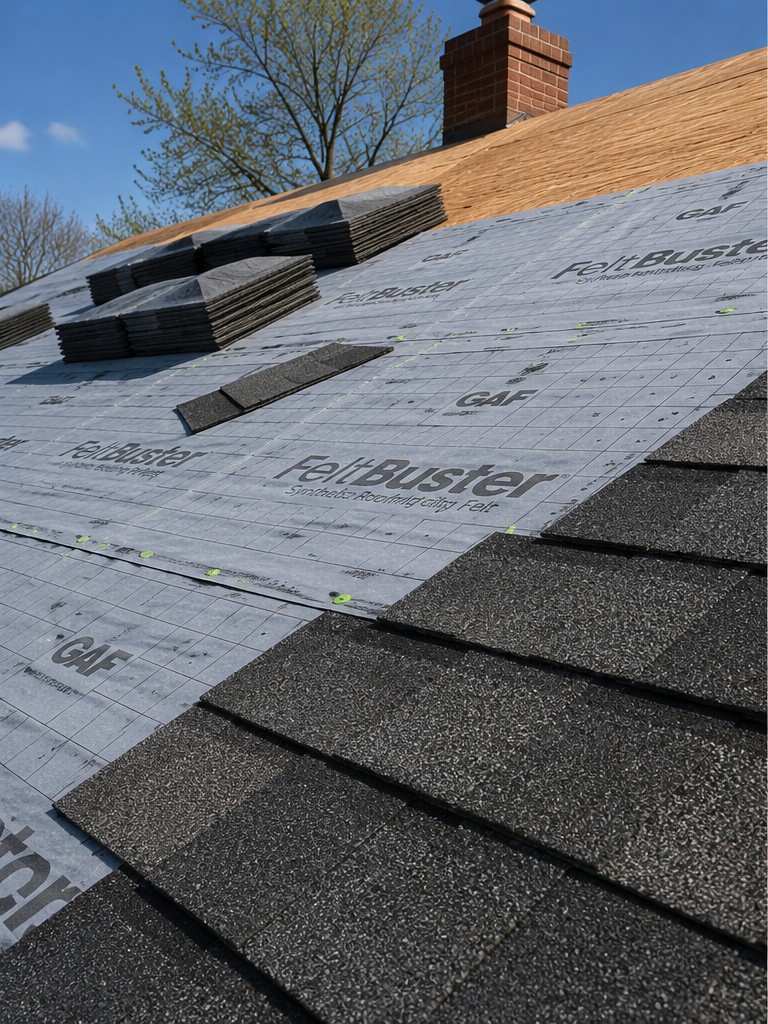
Assigned crews inspect roof decking after tear-off, verify layer limits under adopted IRC re-roofing rules, and specify cold-climate ice barrier (at least 24 in. inside the exterior wall line) plus drip edge at eaves and rakes.
2. Romeoville Permit & HOA Documentation
Where a municipal or county permit is required in Will County, the assigned licensed contractor pulls the permit and coordinates required inspections. Homeowners confirm parcel jurisdiction and any HOA architectural review prior to scheduling.
3. Written Estimate & Storm Documentation
Contractors document physical roof condition with photos and provide an itemized written repair or replacement estimate. Under 815 ILCS 513/18, homeowners pay their insurance deductible; for claim negotiation, consult a licensed public adjuster or attorney.
What to Verify Before Any Romeoville Roof Work Starts
IDFPR License & Insurance
Verify the assigned contractor's Illinois roofing license (225 ILCS 335) on the IDFPR lookup before signing, and request a current certificate of liability insurance and workers' compensation coverage.
Illustrative Local Planning Ranges
Published regional estimates indicate architectural asphalt replacement runs roughly $550–$850 per roofing square installed (about $8,000–$23,000 for a typical 15–27 square home). Your quote depends on roof size, pitch, layers, deck condition, and the assigned contractor's scope.
Written Scope & Warranty Terms
All installation, permitting, and workmanship/manufacturer warranty obligations belong to the assigned contracting entity. Review material specs, underlayment, flashing, and cleanup terms in writing prior to scheduling.
Romeoville Roofing Questions,
Answered
Get Your Free
Romeoville Estimate
On-site assessment and written proposal within 48 hours. Village registration, permits, and HOA documentation all handled by our team.