Roofing Contractor
Aurora, IL
- Certificate of Appropriateness (COA) Expertise: Aurora's five designated historic districts — Near Eastside, Tanner, Riddle Highlands, Palace Street, and the West Side National Register District — require a COA from the Aurora Preservation Commission for any exterior roofing change. We are fluent in Aurora's COA process, and we contact the Preservation Division (630-844-3648) at every estimate for properties in or adjacent to a historic district to determine review requirements before a single shingle is discussed.
- Ventilation Sheet Compliance: Unlike most suburbs, Aurora requires a completed ventilation sheet at permit submission — and the city audits your existing soffit ventilation even if you're not replacing it. An undersized ventilation system triggers a remediation requirement that will delay your project. We calculate net free vent area before every Aurora estimate and include a compliant ventilation sheet with every permit application.
- Aurora's Full Scale — All Five ZIP Codes: Aurora spans two counties (Kane and DuPage), five ZIP codes, and more than 180,000 residents in neighborhoods that range from pre-Civil War Victorian homes on the West Side to late-1990s luxury colonials in Stonebridge and Ginger Woods on the Far East Side. We've worked across all of them — and we know the difference between what a 1920s Tanner District bungalow needs and what a 2001 Far East Side colonial demands.
Aurora is Illinois' second-largest city — a place where an 1856 Italianate on Oak Avenue in the Tanner Historic District stands five miles from a 3,800-square-foot Far East Side colonial in Stonebridge. Where 50 original Sears Catalog Homes still occupy the West Side grid streets alongside seven Lustron all-steel homes that are among the rarest residential structures in the country. Where the Fox River divides the city's east-west geography and its roofing history in equal measure. Since 2005 we've completed over 500 projects across Aurora's five ZIP codes — and we bring the city-specific permit knowledge, historic district experience, and neighborhood-by-neighborhood pattern recognition that a city this complex demands.
Aurora Has One of the Most Documented Severe Weather Histories in Illinois — and Its Oldest Housing Stock Has Never Fully Recovered From It
Aurora's position in the Fox River valley puts it at the convergence of the primary northeast-tracking supercell corridor from the southwest and the secondary moisture channel that flows north from the Illinois River basin. The city holds an Illinois state record: on July 17–18, 1996, Aurora received 16.94 inches of rain in a 24-hour period — the highest one-day rainfall total ever recorded in the state. Nearly every low-lying neighborhood in the city flooded, and the Fox River inundated the blocks immediately adjacent to Stolp Island downtown. Water damage from that event was still being documented in home basements and crawl spaces years afterward. Beyond the 1996 flood, the 1990 supercell thunderstorm that produced the F5 Plainfield tornado passed directly over Aurora first — dropping golf ball–sized hail and producing wind damage across the entire city before continuing to its catastrophic path through Oswego and Plainfield. The combination of that event's hail and the city's stock of aging roofs — many of which were on their second or third system by 1990 — produced a surge of poorly documented emergency replacements that created a generation of Aurora homes where the permit history doesn't match the actual roofing condition. For insurance purposes, that matters enormously.
More recently, the June 2020 and July 2022 DuPage County hail events tracked northeast through Aurora's Far East Side ZIP codes before entering Glen Ellyn and Wheaton. The September 2022 ping-pong ball hail event that centered on Geneva and St. Charles also affected Aurora's northern ZIP codes (60506 and 60505 north). For the Far East Side premium subdivisions — Stonebridge, Ginger Woods, Oakhurst North — those events represent the first significant storm exposure on roofs that were installed in the 1995–2005 window and are now approaching age 20–25. We cross-reference every estimate in the Far East Side ZIPs against NOAA event records and provide full Xactimate documentation on every insurance claim. We attend every adjuster inspection in person — on any Aurora claim across any of the five ZIP codes.
How we manage Aurora storm claimsThe 1990 pre-Plainfield storm produced emergency roof replacements across Aurora that were frequently installed without permits and without full scope documentation. Homes on the West Side and East Side that were re-roofed in 1990–1993 may have permit record gaps that surface in real estate due diligence. A free roof inspection includes a permit history cross-check and can document the current condition on the record before a buyer's inspector does.
Ice Dams in Aurora: Why the West Side Victorian Stock, the East Side Mid-Century Ranches, and Even the 1990s Far East Colonials Are All at Risk
Ice dam risk in Aurora is directly correlated to construction era and geography — and unlike the more homogenous DuPage suburbs to the east, Aurora's housing spans four distinct eras in four geographically separated parts of the city, each with its own ventilation profile and failure pattern. The West Side Victorian and Edwardian stock — the 1850s–1920s homes that form the Tanner Historic District, the Near Eastside Historic District, and the surrounding grid streets — are ice dam machines. Steep-pitch gable roofs with minimal or zero ridge ventilation, original board sheathing with no ice barrier underlayment, and deep eave overhangs from the Victorian era create the perfect thermal dam geometry. On these homes, ice dam damage at chimney flashing, at dormers, and at the first floor eave line is a recurring annual event regardless of how many times the same eave sections have been repaired. The correct fix is always ventilation-first.
The East Side mid-century stock — the 1930s–1960s ranches, bungalows, and two-flats concentrated in the neighborhoods between downtown and Route 59 — shares the ice dam profile of every other DuPage-area mid-century era: shallow roof pitches, undersized attic depths, soffit venting that was sealed in 1970s energy retrofits. Aurora's specific requirement that every roofing permit submission include a completed ventilation sheet — auditing existing soffit ventilation regardless of whether any soffit work is in scope — means that these ice dam–prone homes face a mandatory ventilation disclosure at every re-roofing permit. That is a feature for Aurora homeowners, not a bug: it means you cannot get a new roof in Aurora without the city verifying that your attic ventilation meets the 2021 IRC standard. We calculate ventilation net free area on every Aurora estimate and include the completed ventilation sheet as part of every permit application.
The Far East Side luxury subdivisions from the 1990s and early 2000s are generally well-ventilated by original design — but the 20–25-year-old soffits in these neighborhoods are showing progressive venting panel deterioration that is reducing net free area below the 2021 IRC 1:300 minimum without homeowners being aware of it. We measure soffit intake area on every Far East Side estimate and document any deficit.
Schedule a winter damage or ventilation assessmentTanner District, Palace Street District, West Side National Register area. Italianate, Queen Anne, Craftsman bungalows, and Prairie Style homes with steep pitches, deep overhangs, original board sheathing, and no ridge ventilation. Historic district COA requirements apply to any roofing work here — including ventilation system upgrades that alter visible exterior elements. We navigate the COA process on every ice dam remediation project in Aurora's historic zones.
The dense grid-street neighborhoods east of the Fox River and west of Route 59, including the Near Eastside Historic District area. Shallow-pitch bungalows and ranches with sealed soffit panels from 1970s retrofits. This is the zone where Aurora's mandatory ventilation sheet audit catches the most deficiencies — homes where the attic ventilation ratio is 1:500 or worse, producing reliable ice dam formation every winter with more than 3" of snow accumulation.
Stonebridge, Ginger Woods, Oakhurst North, Harris Farm. Generally well-ventilated by original design but aging soffit panels are progressively reducing net free area. Two-story colonial front wall intersection with the garage roof — a common ice dam initiation point in this era's geometry — is the failure location we most frequently find on Far East Side ice dam repair calls. Not a primary ice dam zone, but not immune.
Aurora 2021 IRC ventilation requirement: The City of Aurora's 2021 IRC adoption requires attic ventilation at 1:300 net free area (or 1:150 with balanced intake/exhaust). Every Aurora roofing permit submission must include a completed ventilation sheet documenting existing soffit and ridge vent area. We prepare this document at no charge on every Aurora project — and we identify deficiencies that need correction before the permit goes in.
From the 1856 Fox River Waterfront to the Far East Side Luxury Corridor — Five Zones, Five Different Roofing Profiles
Aurora is not a typical suburb. It is Illinois' second-largest city — a genuine urban center with a 170-year residential history, five designated historic districts, 50+ Sears Catalog Homes, seven Lustron all-steel houses, and a Far East Side premium subdivision market that rivals Naperville. Serving it well requires knowing all of it.
Aurora Historic District Homeowner Alert — The COA Requirement Covers Roofing
Aurora's five locally designated historic districts — Near Eastside, Tanner, Riddle Highlands, Palace Street, and the West Side National Register District — require a Certificate of Appropriateness (COA) from the Aurora Preservation Commission for any exterior change to a designated historic property, including roofing. The COA process requires an application and review before work can begin; roofing permits in Aurora's historic districts and the FoxWalk District are flagged for additional review by the Building Division. Proceeding without a COA is a code violation that can result in stop-work orders and retroactive removal requirements. We contact Aurora's Preservation Division (630-844-3648, 77 S. Broadway, 2nd Floor) at every estimate for properties in or adjacent to a designated district to determine whether a COA is required — and we prepare and submit the application when it is.

The Fox River west side contains Aurora's oldest and most architecturally significant residential stock — Victorian Italianates and Queen Annes in the Tanner Historic District (established 1998; named for the Tanner House built in 1856 by William Tanner, now the Aurora Historical Museum), the Palace Street Historic District, and the West Side National Register District. The Tanner District alone includes Italianate, Victorian, Queen Anne, Prairie Style, English Cottage, and Craftsman Bungalow homes ranging from the 1850s to the 1930s. Aurora also holds one of the largest concentrations of Frank Lloyd Wright–influenced Prairie Style architecture in the Fox Valley — and the city's architecture includes actual works by Wright, Ludwig Mies van der Rohe, Bruce Goff, and George Grant Elmslie, making Aurora's architectural inventory more significant than most homeowners realize. The COA process applies to all exterior roofing work in the designated districts. The Riddle Highlands Historic District on the east side (primarily Sunset Avenue, Lawndale Avenue, Pennsylvania Avenue, North Lake Street) is separately designated and has its own active grant program — the 2024 preservation grants included multiple Riddle Highlands properties. We are familiar with the COA application, Aurora's Historic District Design Guidelines document, and the review timeline for routine roofing submissions.
Aurora is home to over 50 Sears Catalog Homes — prefabricated homes shipped by rail from the Sears, Roebuck catalog between 1908 and 1940 — and seven Lustron all-steel homes, which are among the rarest post-WWII residential structures in the country. The Lustron homes are a genuine roofing specialty: their porcelain-enameled steel panel roof systems are not replaceable with standard asphalt shingles; any re-roofing of a Lustron requires either specialist restoration of the original panels or a complete structural conversion that typically requires engineering review. The Near Eastside Historic District (East Galena Boulevard, Lincoln Avenue, South Avenue, South 4th Street) is a locally designated historic district with an active COA process. Outside the historic district, the broad East Side stock of 1910s–1940s bungalows, foursquares, and two-story colonials represents Aurora's most active repair market — pipe boots, chimney step flashing, and valley metal oxidation are the endemic failure modes, and most of these roofs carry late-1990s or early-2000s replacement shingle systems that are entering or past their functional age window.
Aurora's mid-century East Side and South Aurora residential stock — the ranches, split-levels, and modest two-stories built between roughly 1940 and 1975 along Indian Trail Road, Ogden Avenue, and the Route 30 corridor — represents the city's largest single housing market by unit count. These homes are on their second or third roofing system. The most consistent failure patterns: blocked soffit ventilation (endemic, due to 1970s energy-crisis insulation retrofits that physically sealed original soffit panels), neoprene pipe boot collar deterioration, and valley metal from 1990s re-roofing installations that is now 25–30 years old. The ventilation issue in this zone is both an ice dam problem and a permit problem: every Aurora roofing permit requires a completed ventilation sheet, and undersized ventilation triggers a remediation requirement that can add cost and timeline to a project if not pre-calculated at estimate time. We run the ventilation calculation before every Aurora estimate and discuss any remediation requirement openly — there are no surprises at permit submission. The Class 4 economics are favorable in this zone: simple rooflines, minimal penetrations, and affordable upgrade cost increments relative to premium savings from carriers active in the 60504/60505 ZIPs.
The Far East Side — developed primarily from the late 1970s through the mid-2000s along the Eola Road and Route 59 corridors, and accelerated by the establishment of the Westfield Fox Valley Mall area — is Aurora's premium residential market. Stonebridge (Stonebridge Country Club, Indian Trail Road west of Eola Road) features custom homes with floor plans from 2,500 to 4,000+ square feet; Ginger Woods (south of Butterfield Road east of Farnsworth Avenue) was built in the early 2000s with averages near $456,000; Oakhurst North (Liberty west of Eola Road) was built by Sterling Homes in the late 1990s. These are ZIP 60502 and 60503 properties — DuPage County addresses even though they are within Aurora city limits, which means they carry the higher property valuations associated with the Naperville/Aurora 204 School District and the DuPage premium. Roofs in this zone are on their first or early second replacement cycle, with most installations from 1997–2006. The June 2020 and July 2022 hail events were the first significant storm exposures for many of these roofs, and we are still finding deferred claims from those events on Far East Side properties that never had an adjuster visit. GAF Golden Pledge® 50-year warranty is standard on all Far East Side replacement projects.
Aurora holds one of the largest documented concentrations of Sears Catalog Homes in the Chicago metro — prefabricated homes shipped by rail from the Sears, Roebuck & Co. catalog between approximately 1908 and 1940, assembled on-site by buyers. These homes present specific roofing challenges: original dimensional lumber framing in non-standard nominal dimensions, board sheathing with gaps that prevent direct nailing into standard sheathing patterns, and in some cases original slate or wood shake roofing that requires specialist assessment before any decision to replace. Sears Catalog Homes are not protected historic landmarks by default — most are eligible for nomination but have not been designated — and most can be re-roofed with standard permits. The seven Lustron homes are a completely different category. A Lustron home's roof consists of porcelain-enameled steel panels that are integral to the structure's thermal and weatherproofing system. These panels are not available from standard roofing distributors; re-roofing a Lustron requires either locating salvage Lustron panels (a specialty market), or a full structural conversion that requires engineering plan review and a building permit different from a standard roofing permit. We are aware of the Lustron homes in Aurora, can identify them by address, and will advise any Lustron homeowner immediately if their property is flagged — and refer them to the specialist resources those homes require.
One Call Gets an Aurora Crew On Your Roof
From Tanner District COAs to a same-day storm inspection in Stonebridge, we've done it across all five Aurora ZIP codes. Get a written estimate within 48 hours.
Aurora's Permit Process Is the Most Detailed of Any Suburb We Serve — Ventilation Sheet, Contractor Registration, and Two Additional Review Queues You Need to Know
The City of Aurora requires a permit for all residential roof replacements and new roof covering installations. Permits are submitted through Aurora's e-TRAKiT Online Portal with a copy of the contract, a completed ventilation sheet, and licensed contractor documentation. Aurora requires roofing contractors to register with the city separately from their State of Illinois Roofing License — registration requires a $200 fee, proof of current State of Illinois licensure, certificate of insurance with $1,000,000 general aggregate and $500,000 per occurrence, and Worker's Compensation coverage. The city must be listed as a primary and non-contributory additional insured on the general liability policy. We maintain current compliance with all Aurora contractor registration requirements and can provide documentation on request.
The ventilation sheet requirement is the single most Aurora-specific feature of the city's permit process. Unlike most suburbs where ventilation is addressed during rough-in inspection, Aurora requires the ventilation calculation to be submitted with the permit application — documenting existing soffit (intake) ventilation and ridge (exhaust) ventilation in square inches of net free area, compared against the 2021 IRC standard. If existing ventilation is deficient, the permit may require documentation of remediation scope. We run this calculation before every Aurora estimate. Standard residential re-roofing permits that don't involve cathedral ceilings, flat roofs, historic districts, the FoxWalk District, structural framing, or complete sheathing replacement are eligible for same-day counter release — we routinely pull same-day Aurora permits for standard residential projects.
For historic district and FoxWalk District properties, the permit is routed for additional review — and a Certificate of Appropriateness from the Aurora Preservation Commission is required separately before the building permit can issue. We manage the COA application and coordinate the sequence with the Building Division so the two approvals arrive in the correct order. Contact the Aurora Preservation Division at 630-844-3648 or the Building Division permit counter at permitcounter@aurora.il.us for questions on any specific property's requirements.
| Requirement | City Standard | Our Performance | Why It Matters |
|---|---|---|---|
| Ice & Water Shield | 24" inside exterior wall per 2021 IRC R905.1.2; valley coverage required | Exceeds — full eave coverage standard | Critical for West/East Side pre-war stock. |
| Ventilation Sheet | Required at permit submission — existing soffit audited | Pre-calculated at estimate, included in permit package | Deficiency = remediation requirement and permit delay. |
| Max Shingle Layers | No 3rd layer — if 2+ layers exist, full tear-off required | Layer count documented at every estimate | Prevents illegal installs that void warranty and insurance. |
| Contractor Registration | City registration + IL State license + $1M GL + Worker's Comp | Current — all docs on file, verifiable | Unregistered contractor = permit void, homeowner liability. |
| Historic District Permit | Additional review — COA required before permit issues | COA application managed — Preservation Division coordinated | COA required for roofing, windows, siding on designated properties. |
| Drip Edge | Required at eaves and rakes per 2021 IRC R905.2.8.5 | Standard heavy-gauge on every project | Prevents fascia rot and water infiltration at rake. |
| Standard Permit Speed | Same-day counter release if complete package submitted | We routinely pull same-day Aurora residential permits | Complete package = no delays; incomplete = re-submission queue. |
Aurora has adopted the full 2021 International Residential Code (IRC) along with the 2021 IBC, IMC, IFGC, IFC, IPC, IEBC, IECC, ISPSC, and the 2023 National Electrical Code. This makes Aurora's code base one of the most current in the region — ahead of Glen Ellyn (2018 IRC) and on par with Wheaton's 2024 IRC for most residential purposes. The 2021 IRC's attic insulation and ventilation standards apply at every Aurora re-roofing permit, which is why Aurora's ventilation sheet requirement is not merely bureaucratic — it's the city ensuring that the ventilation standard is actually met on every project, not just documented on paper.
The Most Common Leak Sources in Aurora — From Victorian Chimney Flashing to Far East Side Post-Storm Callbacks
Five hundred projects across Aurora's full geographic and era range gives us failure-pattern knowledge that most contractors — who work a fraction of Aurora's ZIP code coverage — simply cannot offer. We know what fails in a Tanner District Queen Anne and what's leaking in a 2001 Stonebridge colonial after the 2020 storm. The actual leak source and the reported symptom are often two different locations.
Historic West Side & Bungalow Era Failures
For Aurora's Victorian and Edwardian West Side homes — Tanner District, Palace Street, West Side National Register area — the dominant failure cascade is consistent across the era: chimney counter flashing fails first, then step flashing at the same chimney, then the ice dam–water pathway through the eave board opens at the wall top plate. Repairs that address only the visible symptom (the interior ceiling stain) while leaving the chimney flashing in place will re-leak within 12–18 months. On every West Side historic-era repair call, we inspect the full chimney assembly, the valley from ridge to eave, and the eave from above. For COA properties, we also document that the repair materials we're proposing are code-consistent with the Aurora Historic District Design Guidelines — some flashing material specifications require review even in repair scope.
Roof repair servicesMid-Century East Side & 1970s Era Failures
The East Side mid-century bungalows and ranches — a large proportion of which received tear-off replacements in the emergency roofing surge after the 1990 pre-Plainfield hail event — are on their second system now, and many of those second systems are showing consistent failure modes: cracked pipe boot collars, oxidized valley metal at the 25–30 year mark, and high-nail pattern shingles that were installed in the early 1990s when 4-nail patterns were standard (before the 6-nail requirement for wind resistance). On re-inspection of any mid-century Aurora repair call, we document existing shingle fastening patterns and identify sections that have shifted from their original fastening — a telltale sign of wind-created tab displacement that hasn't produced a visible leak yet but will. The ventilation sheet requirement for any permit work in this zone also triggers a mandatory soffit inspection — and we almost always find blocked intake panels in this era's stock.
Roof repair servicesFar East Side Post-Storm Callbacks & Repair vs. Replace
The Far East Side luxury subdivisions — Stonebridge, Ginger Woods, Oakhurst North — are generating the same post-storm secondary failure pattern we see across DuPage County: repairs done quickly after the 2020 or 2022 events that left the adjacent damage in place. On Far East Side secondary failure calls, we most frequently find pipe boots that weren't in the original repair scope but were stressed by the storm event, dormer side wall flashing that was loosened at the lap joint and is now wicking at the wall assembly, and valley sections with micro-fractures in the sealant lap from impact. The Far East Side's premium price points — Stonebridge homes regularly transact above $450,000, Ginger Woods near $456,000 average — mean the repair-vs.-replace calculus always warrants a written analysis. A full replacement with GAF Golden Pledge® coverage eliminates the callback cycle permanently, and on a DuPage-ZIP 60502 or 60503 property, the replacement cost value typically justifies it.
Repair vs. replace analysisRoofing Services We Provide in Aurora
Roof Replacement
Full tear-off and replacement across all Aurora ZIP codes — 60502, 60503, 60504, 60505, 60506. GAF Master Elite® certified with Golden Pledge® 50-year warranty available. From a 1,200 sq ft East Side bungalow to a 4,000 sq ft Far East Side colonial. Historic district COA and ventilation sheet managed on every Aurora project.
Roof Repair
Leak investigation and repair across all Aurora construction eras. Tanner District Victorian chimney step flashing, East Side mid-century pipe boots and valley metal, Far East Side post-storm secondary failures. Full written condition report on every repair call — not just the symptom location.
Storm Damage & Claims
Hail and wind damage documentation for all Aurora ZIPs. Adjuster accompaniment, Xactimate supplement submission, Illinois Matching Law documentation. All carriers active in Aurora — State Farm, Allstate, Farmers, Country Financial, Erie, USAA, American Family. Far East Side DuPage-ZIP 60502/60503 policies carry premium RCV coverage warranting full documentation scope.
Asphalt Shingles
Full GAF product line including Timberline HDZ®, ArmorShield II® Class 4, and designer series for Aurora's historic-zone premium homes. Physical samples at every estimate. For historic district properties: COA-reviewed alternative material documentation prepared for Aurora Preservation Commission submissions when material changes are proposed.
Gutters & Downspouts
Seamless aluminum and copper gutter installation and hail impact replacement. Copper gutter options for Tanner District and West Side historic-era properties where original copper profiles require matching. Gutter denting is consistently underscoped in Aurora insurance claims — we document every impact-dented linear foot at adjuster inspections.
Roof Inspections
Free 30-point inspections — post-storm, pre-listing, pre-purchase, annual maintenance. Written condition report with photos, condition grade, remaining-life estimate, and permit history cross-check. For Aurora's active real estate market spanning price points from $200K to $500K+, documented roof condition is critical to protecting sale price at every tier.
What Our Work in Aurora Actually Looks Like
Over 500 completed projects across all five Aurora ZIP codes. These three examples represent the scenarios we manage most often — Tanner District COA navigation, Far East Side insurance claim recovery, and East Side ventilation-driven replacement.
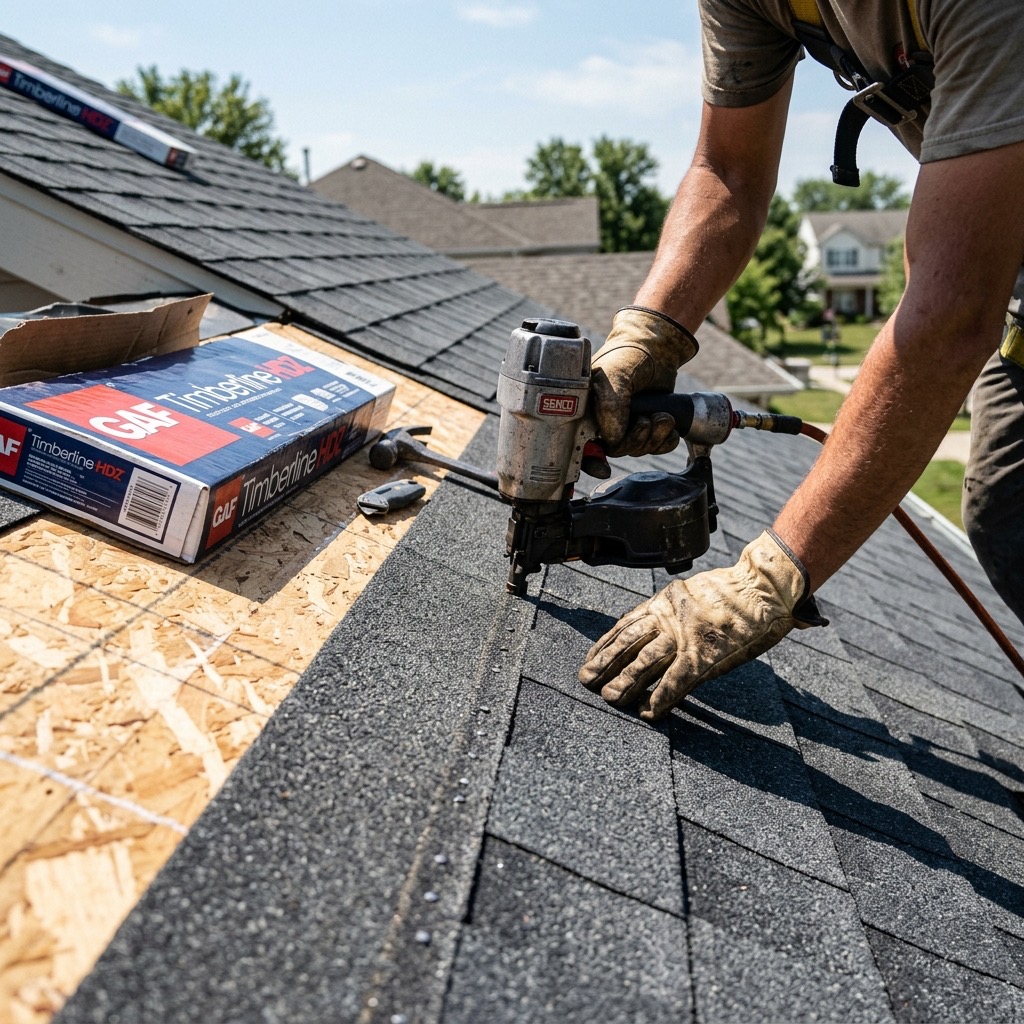
1902 Queen Anne on Oak Avenue in the Tanner Historic District — one of Aurora's most photographed Victorian streetscapes. The home had been re-roofed in the late 1990s with an asphalt shingle that was no longer in production, and the July 2022 storm produced functional damage across the entire south-facing slope. Allstate's initial scope identified the damaged south slope only and did not acknowledge the Illinois Matching Law for the discontinued profile. We prepared and submitted a COA application to the Aurora Preservation Commission for the proposed replacement material — a GAF Camelot II® designer shingle that closely replicates the visual weight and shadow depth of the original Victorian-era aesthetic without using a profile that required custom manufacturing. The Commission approved the COA in a standard review cycle. Simultaneously, we submitted an Xactimate supplement to Allstate documenting the discontinued profile and invoking the Illinois Matching Law across all connected planes — expanding the approved scope from the south slope to the full roof. Allstate approved the expanded scope. The homeowner's out-of-pocket was their deductible. Golden Pledge® 50-year warranty issued.
3,400 sq ft colonial in Stonebridge — ZIP 60502, DuPage County valuation, Naperville/Aurora 204 School District. State Farm's post-2020 storm inspection approved replacement on the rear slopes (most severely impacted) and denied the front slopes as cosmetic-only damage, citing the storm's position relative to the property's orientation. The homeowner had accepted the partial approval and waited. After the September 2022 ping-pong ball hail event, we were called to inspect. We found: (1) the 2020 damage was still present on the front slopes — State Farm's cosmetic classification was incorrect under HAAG methodology; (2) the 2022 event added additional functional impact points to all slopes. We submitted a combined supplement and re-opened the 2020 partial claim alongside the new 2022 filing, documenting that the 2020 front slope damage was still within the State Farm policy's applicable recovery window. State Farm approved the combined filing for full RCV replacement on all slopes. The homeowner received a $3,200 supplement above the prior partial payment. Class 4 ArmorShield II® installed; 27% State Farm premium reduction confirmed. Golden Pledge® 50-year warranty issued.
1958 ranch on the East Side — re-roofed in 2007, recurring ice dam damage every winter since 2011. The homeowner had called other contractors over the years and received quotes to repair the eave flashing, which temporarily addressed the interior leak but never resolved the ice dam formation. When we inspected for a replacement estimate, we pre-calculated the ventilation sheet as required for the Aurora permit package and found: net free vent area at 1:480 (less than half the 1:300 minimum required by the 2021 IRC Aurora adoption). Every soffit intake panel had been spray-foam sealed from the interior during a 1979 insulation upgrade. The homeowner had been paying for ice dam repairs for 13 years when the actual problem was a ventilation ratio that was guaranteeing dam formation regardless of what material was on the roof. We replaced the roof with GAF Timberline ArmorShield II® with full eave ice-and-water shield to 36" above the interior wall, cut new ventilated soffit panels to restore original intake area, and added a continuous ridge vent. The permit ventilation sheet passed on first submission. No ice dams the following winter — for the first time since 2010. Farmers Insurance issued a $310/yr premium reduction for the Class 4 product certification.
What Aurora Homeowners Say
Verified Google reviews from Aurora, IL homeowners. See all 312+ reviews →
"We have a 1902 Queen Anne in the Tanner Historic District and every contractor we'd called before gave us a quote without even mentioning the Certificate of Appropriateness. Naperville Roofing Crew knew about the COA requirement immediately, handled the application to the Preservation Commission, got the material change approved, AND got our Allstate claim expanded via the Illinois Matching Law. We paid our deductible. New roof looks stunning on the Victorian. These are the only people who actually know what they're doing in Aurora's historic districts."
"We're in Stonebridge and our State Farm claim after the 2020 storm only covered the back of the roof. We accepted it because the adjuster made it sound final. Two years later the front slopes were also visibly damaged. Naperville Roofing Crew reopened the 2020 claim alongside our 2022 filing, proved the front damage was functional damage from 2020 that State Farm had misclassified, and got us a $3,200 supplement on top of what we'd already received. They installed Class 4 shingles and our premium went down 27%. Could not believe they could do all of that."
"Thirteen years of ice dams. Three different roofers, three temporary fixes. Naperville Roofing Crew looked at the roof for the Aurora permit ventilation sheet, found our soffit venting was basically zero percent of what it should be, and explained that no roofing product was going to stop the ice dams as long as that was the situation. They fixed the ventilation, put in the new roof with proper ice barrier, and we had no ice dams last winter for the first time since we moved in. I wish I'd called them ten years ago."
Roofing FAQ for Aurora Homeowners
Does my Aurora property require a Certificate of Appropriateness (COA) before getting a new roof?
Only if your property is within or adjacent to one of Aurora's five locally designated historic districts (Near Eastside, Tanner, Riddle Highlands, Palace Street, or the West Side National Register District), or is itself a designated Aurora landmark. For these properties, a COA from the Aurora Preservation Commission is required for any exterior change — including roofing — before a building permit can issue. The COA application goes to the Preservation Division at 77 S. Broadway, 2nd Floor, Aurora, IL 60505 (phone: 630-844-3648). For properties outside the designated districts, no COA is required — just a standard roofing permit through Aurora's e-TRAKiT portal. Standard residential roofing permits that include a complete package (contract, ventilation sheet, contractor documentation) are typically released same-day. We determine COA requirements at every estimate for properties in potential historic zones. If you are unsure whether your property is in a historic district, the Preservation Division can confirm by address — or we can check on your behalf as part of the estimate process.
Why does Aurora require a ventilation sheet with every roofing permit?
Aurora's e-TRAKiT roofing permit application specifically requires a completed ventilation sheet as part of the submission package — even if you are not touching the soffit system as part of the roofing project. The reason: anytime a change is made to a roof, the City of Aurora requires confirmation that the entire completed assembly — including existing ventilation — meets the current 2021 IRC standard. The ventilation sheet documents your existing soffit (intake) net free area and ridge or other exhaust net free area in square inches, compared against the IRC's 1:300 requirement (or 1:150 with balanced intake/exhaust). If existing ventilation is deficient, the permit may require documentation of remediation scope. This means that for the large population of Aurora's East Side mid-century ranches and bungalows — where 1970s energy retrofits sealed soffit panels — the ventilation deficiency will be discovered and documented at permit submission. We pre-calculate the ventilation sheet at every Aurora estimate so that any deficiency is known and costed before you sign a contract, not discovered at permit review.
Can I add a new layer of shingles over my existing roof in Aurora?
No — not if you already have two or more layers. The City of Aurora's roofing requirements explicitly state: if there are two or more existing shingle layers on the roof, all existing layers must be completely removed (full tear-off) before any new roofing material can be installed. Aurora does not permit a third layer of shingles under any circumstances. A first overlay (adding one layer over one existing layer) is technically permissible but rarely advisable — it eliminates access to the deck for inspection, it voids most manufacturer warranties including GAF's, and it adds weight that older framing may not support at code. We document the existing layer count at every Aurora estimate and disclose whether a tear-off is required. For any home with an unknown layer count — common in Aurora's older East Side stock, where multiple emergency re-roofs over several decades may have been done without permits — we do a probe inspection at the eave edge to confirm the actual layer count before providing a quote.
How much does roof replacement cost in Aurora?
Aurora's price range is wider than any other market we serve because the city spans a greater range of home sizes and values than any other suburb in our territory. A straightforward East Side bungalow or ranch (900–1,600 sq ft, simple pitch, 2 pipe boots, no dormers) runs $7,500–$11,500 with GAF Timberline HDZ® including permit, tear-off, full eave ice barrier per the 2021 IRC requirement, and all flashings. A mid-century East Side two-story (1,800–2,400 sq ft, moderate complexity) runs $11,500–$16,000. Far East Side colonials in Stonebridge or Ginger Woods (2,800–4,000 sq ft) run $18,000–$30,000+. Historic West Side Victorian homes with complex gable geometry, dormers, and COA requirements run $20,000–$40,000+ depending on scope. For storm insurance replacements, the applicable RCV less deductible is the homeowner's typical out-of-pocket on an RCV policy. See our 2026 Roof Replacement Cost Guide for current Xactimate pricing across Kane and DuPage County ZIP codes.
I have a Lustron all-steel home in Aurora. Can it be re-roofed normally?
No — not with standard asphalt shingles installed in the normal way. A Lustron home's roof system consists of porcelain-enameled steel panels that are part of the building's integrated thermal and weatherproofing assembly. These panels are not available through standard roofing distributors and are not covered by standard roofing warranties. Re-roofing a Lustron home has two primary options: (1) restoration using salvaged original Lustron panels sourced through the specialist salvage market, which is limited in availability; or (2) a complete structural conversion that removes the Lustron panel system and installs conventional framing, sheathing, and roofing, which requires an engineering plan review and a building permit beyond a standard roofing permit — and typically requires the Aurora Preservation Division to weigh in on whether the conversion affects the structure's historic character. Aurora has seven documented Lustron homes. We can identify them by address and will advise any homeowner immediately if their property is a Lustron — and we do not quote standard re-roofing work on a Lustron home. If you believe you have a Lustron and aren't sure, we'll confirm at the inspection at no charge.
My Far East Side home had a storm claim approved in 2020 but only partially. Is it too late to reopen it?
It depends on your carrier's policy terms and the elapsed time since settlement, but it is often not too late — and it's always worth a professional inspection to determine what you're working with. Illinois homeowners insurance policies typically include a provision for reopening or supplementing a previously approved claim when additional covered damage is identified. The window for this process varies: some carriers allow up to two years from the date of settlement, not from the date of the storm. If a new storm event has occurred since the original claim and caused additional damage, that creates a separate, current claim that can be filed independently — which is the scenario we frequently encounter on Far East Side properties that had partial 2020 approvals and subsequently experienced damage in the 2022 events. In the case we documented in our project examples above, we successfully merged a 2020 partial approval with a new 2022 filing on a Stonebridge colonial and recovered an additional $3,200. We perform a combined damage assessment and timeline analysis on every Far East Side inspection call and advise on what approach is most likely to succeed with your specific carrier. There is no charge for the inspection or the carrier-specific strategy review.
What building code does Aurora use for roofing — and why does it matter?
The City of Aurora has adopted the 2021 International Residential Code (2021 IRC) along with the complete 2021 ICC code family and the 2023 National Electrical Code — making Aurora one of the most current code jurisdictions in the Chicago western suburbs, alongside Wheaton (2024 IRC) and ahead of Glen Ellyn (2018 IRC). For roofing, the 2021 IRC specifies: ice barrier required from the fascia to 24 inches inside the interior wall (per R905.1.2), drip edge mandatory at eaves and rakes, solid sheathing required, and ventilation at 1:300 net free area (or 1:150 with balanced systems). The ventilation requirement is enforced through Aurora's mandatory ventilation sheet at permit submission — which is the most operationally significant code enforcement mechanism for roofing in Aurora. If your existing ventilation doesn't meet the 2021 IRC standard, the permit will flag it, and remediation documentation may be required. We calculate ventilation compliance at every estimate and present the results — and any correction options — before you commit to a project scope. This is not a minor procedural detail: ventilation deficiency is the direct cause of ice dams in the majority of Aurora's East Side mid-century homes.
Is Class 4 impact-resistant shingles worth it in Aurora's ZIP codes?
For most Aurora homeowners — particularly in the Far East Side DuPage ZIP codes (60502 and 60503) where policy premiums are higher due to elevated home values — the Class 4 upgrade is typically a 3–6 year payback proposition. The upgrade adds $1,500–$5,000 to replacement cost depending on roof size. State Farm, Allstate, Farmers, Country Financial, and most other carriers active in Aurora offer 20–30% premium discounts on the wind/hail rider for a certified Class 4 installation with a completed GAF UL 2218 Class 4 certificate. On a Stonebridge or Ginger Woods property where annual wind/hail premiums are higher than the Kane County side of Aurora, the annual premium savings can reach $400–$900/year, paying back the upgrade in 4–6 years. On the East Side and West Side Kane County ZIPs (60505, 60506), premiums are lower — the savings are real but the payback may be 6–8 years, which is still a financially sound decision given a 25–30 year expected roof life. We run the exact payback calculation at every estimate using your specific ZIP code and current policy information — bring your declaration page and we'll tell you precisely what your carrier will discount.
How do I verify that an Aurora roofing contractor is properly registered?
Aurora's contractor registration requirements are more specific than most suburbs. Before signing with any contractor in Aurora, verify: (1) they hold a current State of Illinois Roofing License (required by state law for all roofing contractors regardless of municipality); (2) they are registered with the City of Aurora as a Roofing Contractor with the $200 annual registration — you can confirm this by contacting Aurora's Building Division permit counter at permitcounter@aurora.il.us; (3) they carry general liability insurance of $1,000,000 general aggregate and $500,000 per occurrence with the City of Aurora listed as a primary and non-contributory additional insured; (4) they carry Worker's Compensation in compliance with Illinois statutes; (5) they are familiar with the ventilation sheet requirement — if they don't know what that is, they are not pulling Aurora permits routinely; (6) for historic district properties, they know Aurora's COA process and can confirm whether your property requires one. A contractor who cannot explain Aurora's ventilation sheet requirement has either never pulled a permit in this city or is planning to not pull one on your project. Both are disqualifying. We provide documentation of all registration items on request — contact us before your estimate if you want to verify our current compliance status.
Request a Free Estimate in Aurora
We've served all five of Aurora's ZIP codes since 2005 — from the Victorian streets of the Tanner Historic District to the premium colonials of Stonebridge and Ginger Woods. Over 500 completed projects across Kane and DuPage County within Aurora city limits. On-site assessment and written proposal within 48 hours. Ventilation sheet pre-calculated. Historic COA process managed directly.